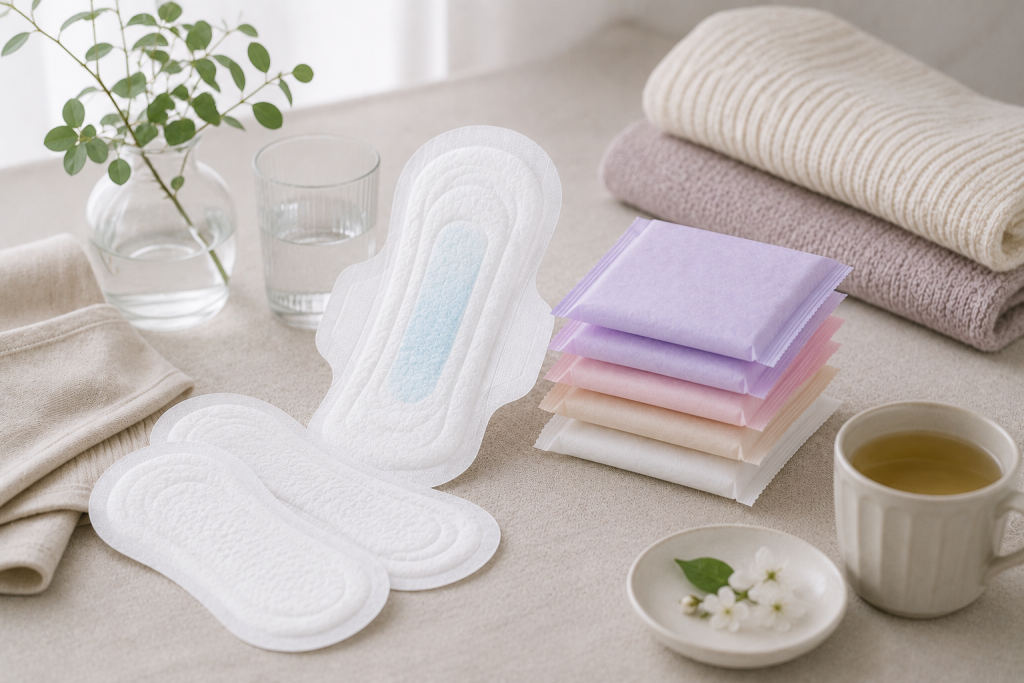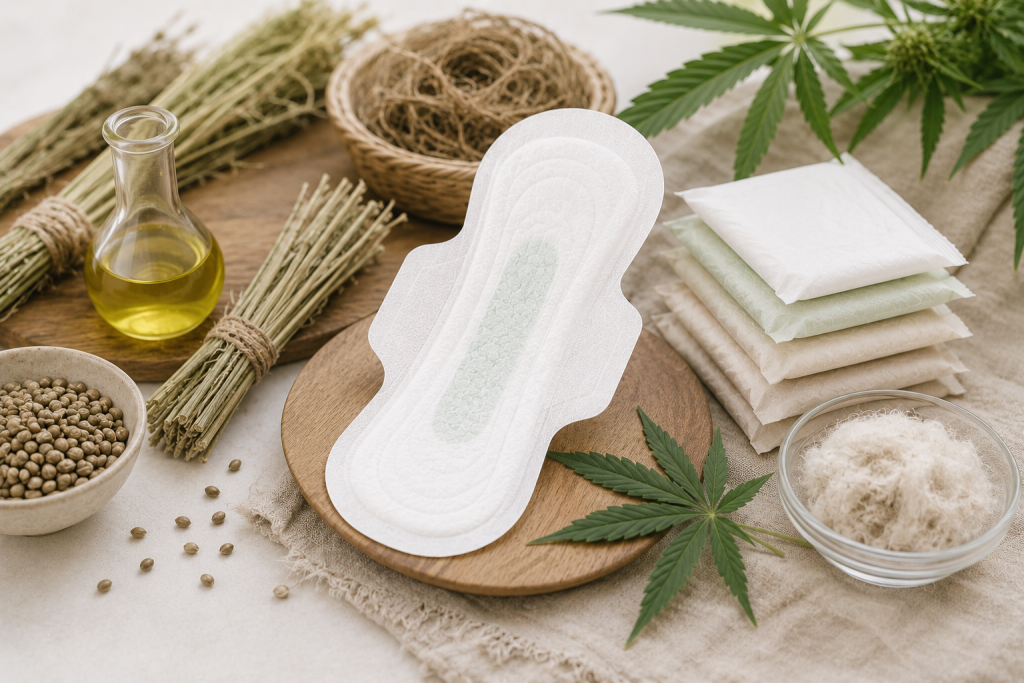
About This Guide
This guide covers the main types of women's sanitary pads used for period care and feminine hygiene — how they are constructed, how absorbency levels work, what material options are available, and how the category is structured for consumers and for brand owners evaluating private label product directions. It is useful for consumers choosing the right pad, and for importers and distributors who want to understand the product category before approaching a manufacturer.
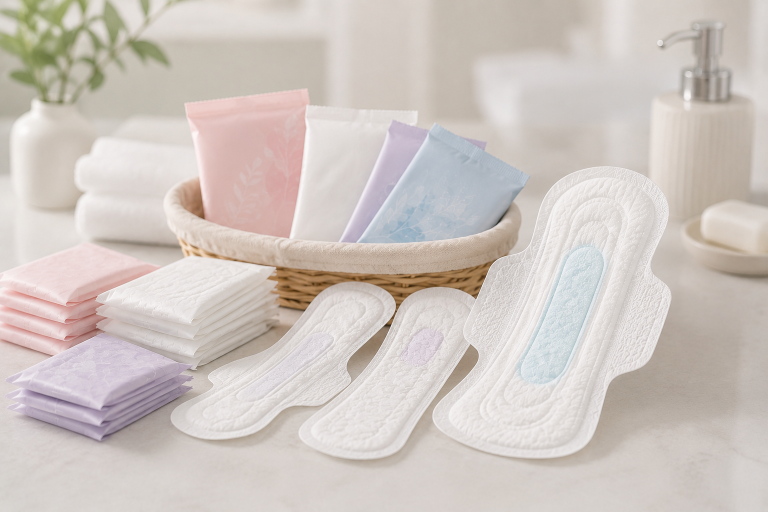
What Are Women's Sanitary Pads and How Do They Work?
Sanitary pads — also called menstrual pads, period pads, or sanitary napkins — are absorbent products worn externally in the underwear to collect menstrual flow. They are the most widely used period care product globally, used across all markets and age groups.
A modern sanitary pad typically consists of several functional layers working together:
- Topsheet — the layer in direct contact with the skin; transfers fluid quickly into the core while keeping the surface feeling dry
- Acquisition and distribution layer — spreads fluid across the core for more efficient absorption
- Absorbent core — holds the majority of fluid; usually a combination of fluff pulp and superabsorbent polymer (SAP)
- Backsheet — the bottom layer that prevents fluid from passing through to the underwear; usually a breathable PE film
- Adhesive strip — secures the pad in place in the underwear
- Wings (on winged designs) — fold around the gusset of the underwear to prevent side movement and leakage
The performance of a sanitary pad — how well it absorbs, how dry it keeps the surface, and how reliably it prevents leakage — depends on the quality and construction of these layers working together, not on any single component alone.
Types of Women's Pads: A Complete Overview
| Type | Primary Use | Key Features | Typical Length |
|---|---|---|---|
| Panty liner | Light discharge, spotting, daily freshness | Very thin, minimal core, usually no wings | 150–180mm |
| Regular / Day pad | Light to moderate flow during daytime | Standard core weight, wings optional | 230–270mm |
| Heavy / Maxi pad | Heavy flow days, longer wear intervals | Higher core weight, reinforced leak barriers, wings standard | 280–310mm |
| Overnight pad | Sleep protection, maximum flow coverage | Extended length, wider back panel, high SAP concentration | 330–420mm |
| Organic cotton pad | Skin-comfort and natural material positioning | Organic cotton topsheet, fragrance-free, FBA-free; available across all absorbency levels | Varies by absorbency |
| Herbal / functional pad | Differentiated comfort or freshness positioning | Herbal chip or anion chip embedded in core; comfort and freshness-oriented product direction | Varies by absorbency |
Topsheet Material Options: What Affects Comfort and Positioning
The topsheet is the layer consumers feel most directly during wear. Material choice affects surface comfort, breathability, and how the product is positioned in the market.
- Soft nonwoven — the standard topsheet material; smooth surface, good fluid transfer, cost-effective for mainstream positioning
- Organic cotton — softer surface feel, associated with natural and skin-friendly positioning; increasingly preferred in developed markets for premium and sensitive-skin product lines
- Mesh / perforated film — used in some ultra-thin designs; fast fluid transfer, less soft against skin
- Bamboo fiber — used in some eco-oriented product lines; soft feel, natural material positioning
Topsheet material is one of the primary customization decisions in an OEM pad project. It affects product feel, positioning, and cost — but does not directly determine absorbency capacity, which is controlled by the core construction.
How Absorbency Levels Work Across the Product Range
Absorbency in sanitary pads is determined by the core construction — specifically the weight of the absorbent core and the concentration of superabsorbent polymer (SAP). Higher core weight and SAP concentration means higher fluid capacity and better dry-back performance under pressure.
For consumers, choosing the right absorbency level is the most important product decision — more so than brand, material, or price. A pad that is too low in absorbency for the current flow will leak; a pad that is too high is unnecessary but not harmful.
For brand owners, absorbency range determines SKU count. A minimum practical range for a private label sanitary pad line typically includes a day pad and an overnight pad. Adding a heavy variant or an ultra-thin variant expands market coverage but increases total MOQ commitment. For more detail on how SKU structure and MOQ interact in OEM pad projects, see our guide on OEM sanitary pads: MOQ, packaging, and lead time explained.
Sanitary Pads vs. Other Period Care Products
Pads are the most widely used period care product globally, but they are used alongside — and sometimes compared to — other formats. Understanding where pads fit relative to other options is useful for both consumers and brand owners planning a product range.
| Product | How It Works | Best For | Key Limitation |
|---|---|---|---|
| Sanitary pad | External absorption | Everyday use, overnight, all flow levels | Not suitable for swimming |
| Tampon | Internal absorption | Swimming, sport, fitted clothing | Requires insertion; must be changed every 4–8 hours |
| Period underwear | External absorption via built-in layer | Overnight, backup, light flow | Requires changing full garment; reusable versions need washing |
| Menstrual cup | Internal collection | Long wear duration, low waste | Requires insertion and emptying; learning curve for new users |
Many consumers use a combination of products across their cycle — for example, pads for everyday and overnight use, with tampons or period underwear for specific activities. For brand owners, this reinforces the value of a multi-category product range that addresses different use occasions. For a comparison of period underwear and tampons specifically, see our guide on period underwear vs. tampons: pros, cons, and what to choose.
Frequently Asked Questions
How often should sanitary pads be changed?
Pads should be changed every 3–6 hours during regular flow, every 2–3 hours during heavy flow, and within 8 hours for overnight use. Changing regularly — regardless of whether the pad appears full — reduces the risk of odor, skin irritation, and bacterial growth from prolonged moisture contact.
What is the difference between a sanitary pad and a panty liner?
Panty liners are a thinner, lower-absorbency version of sanitary pads, designed for light discharge, spotting, or everyday freshness rather than menstrual flow management. They use a lighter core with minimal SAP content and are typically shorter and thinner than regular pads. For a detailed comparison of both categories from an OEM perspective, see our guide on panty liner vs sanitary pad OEM: key differences for brand owners.
Are organic sanitary pads better than regular pads?
Organic pads are not more absorbent than regular pads — absorbency is determined by the core construction, not the topsheet material. Organic cotton topsheets offer a softer surface feel and are free from synthetic fragrances and fluorescent brightening agents, which makes them a preferred choice for users with sensitive skin or those seeking cleaner product formulations. Whether organic pads are "better" depends on the individual user's priorities.
What does FBA-free mean on a sanitary pad?
FBA-free means the product contains no fluorescent brightening agents — chemicals sometimes used in textile and paper manufacturing to make materials appear whiter. FBA-free is a meaningful product attribute for skin-sensitive users and is a verifiable claim through third-party testing. Niceday products are manufactured without fluorescent brightening agents as a standard production requirement.
For brand owners: what is the minimum range needed to launch a private label sanitary pad line?
A practical minimum launch range typically includes a regular day pad and an overnight pad — covering the two most common use occasions. Each is a separate SKU with its own MOQ requirement. Adding a heavy flow variant or a panty liner expands the range but increases total order commitment. Most new brands start with two to three SKUs and expand in subsequent orders based on market feedback.
For Brand Owners and Importers: Sanitary Pads as a Private Label Category
Sanitary pads are the largest and most established product category in feminine hygiene globally. For private label brands and importers, this means both a large addressable market and significant competition in most markets. Successful private label pad brands typically differentiate through one or more of the following directions:
- Material positioning — organic cotton, bamboo fiber, or other natural topsheet materials for skin-comfort and clean-ingredient positioning
- Functional differentiation — herbal-inspired or anion freshness product concepts that offer a distinct consumer experience
- Packaging quality — premium packaging design that elevates shelf presence above standard market options
- Market-specific fit — product specifications and positioning adapted to the preferences and expectations of a specific target market
For a full overview of how to plan and launch a private label sanitary pad line — including manufacturer evaluation, MOQ, lead time, and packaging — see our guide on how to start a private label feminine hygiene brand.
Looking for a Sanitary Pad OEM Manufacturer?
Niceday manufactures sanitary pads across a full range of types, absorbency levels, and material directions — including organic cotton, herbal-inspired, and functional freshness product concepts. Our facility in Foshan, China operates 14 intelligent production lines with daily capacity of 9.8 million pieces, supplying private label brands and distributors in 54+ countries.
Tell us your target market, product type, and brand direction — our OEM team will respond with relevant product options and next steps.
Contact Our OEM Team View OEM Service Details