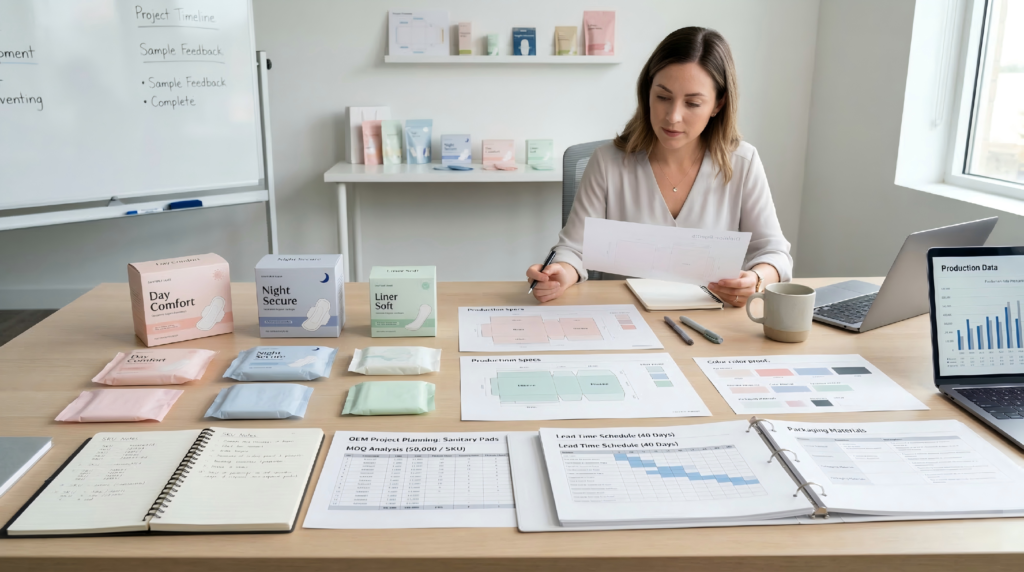
When working with a private label sanitary pad manufacturer, understanding MOQ (Minimum Order Quantity), lead time, and packaging is essential for successful collaboration. These key factors will determine your production capacity, timeline, and cost structure, directly impacting the success of your product launch. This article will help private label brands understand the different aspects of MOQ, packaging, and lead time, and how to navigate these complexities to ensure a smooth production process.
Why MOQ, Packaging, and Lead Time Matter
In private label sanitary pad development, product quality is only one part of the project. MOQ, packaging, and lead time directly affect launch planning, budget allocation, SKU decisions, and speed to market.
For buyers, these factors influence:
- how many SKUs can be launched at one time
- whether the product concept is commercially realistic
- how efficiently packaging can be developed
- whether the project can meet market timing requirements
- how much coordination is needed between brand, supplier, and production teams
Because of this, MOQ, packaging, and lead time should be discussed as core project factors, not treated as secondary details.
What MOQ Means in OEM Sanitary Pad Projects
MOQ stands for minimum order quantity. In OEM projects, MOQ is the lowest production volume a manufacturer can accept for a given product setup. MOQ is important because it affects:
- project entry cost
- SKU planning
- packaging complexity
- production efficiency
- inventory risk
For buyers launching a new private label line, MOQ should be considered carefully. A lower MOQ may reduce launch risk, but it may also limit certain customization options. A more complex product structure or packaging format may require a higher MOQ to make production practical.
MOQ also varies depending on product specification, packaging format, and customization level. In practice, standard private label projects are usually easier to plan than highly customized packaging programs, which often require greater volume coordination.
What Can Affect MOQ
- Product Specification Complexity
- Packaging Format
- Number of SKUs
- Custom Printing and Artwork

Why Packaging Should Be Discussed Early
In OEM sanitary pad projects, packaging is not only a design task — it affects lead time, material planning, SKU setup, and overall project coordination.
Buyers should avoid treating packaging as something to finalize at the last moment. In many cases, packaging decisions affect:
- production scheduling
- print file preparation
- approval cycles
- packaging material sourcing
- final launch timing
At Niceday, packaging development is often one of the most important parts of private label coordination because it directly connects product readiness to market readiness.
What Influences Lead Time in OEM Projects
Lead time in OEM sanitary pad development is not only about factory production days. It includes multiple stages from requirement confirmation to packaging approval and final production coordination.
Common lead time factors include:
- Product Brief Clarity
- Sampling and Revision Cycles
- Packaging Confirmation
- SKU Quantity
- Production Scheduling
Common Buyer Questions About MOQ and Lead Time
Not necessarily. A lower MOQ can reduce initial risk, but it may also limit product options, packaging flexibility, or cost efficiency. Buyers should balance launch risk with commercial practicality.
Yes. In many OEM projects, packaging is one of the main reasons timelines become longer. Delayed artwork, approval, or print coordination can affect the final production schedule.
No. Lead time depends on product complexity, packaging requirements, approval speed, SKU count, and production planning.
That depends on the launch strategy. In some cases, starting with fewer SKUs helps simplify MOQ and packaging coordination. In other cases, a broader launch may make more sense if the market already supports it.
What Buyers Should Prepare Before Contacting a Manufacturer
To make discussions more productive, buyers should prepare:
- target market
- product category and size range
- desired positioning
- number of SKUs
- packaging format
- artwork status
- expected launch schedule
- estimated order scope
This helps the manufacturer evaluate the project more accurately and improves communication from the start.
Conclusion
Understanding MOQ, packaging, and lead time is crucial when selecting a private label sanitary pad manufacturer. By evaluating these factors and negotiating with your manufacturer, you can ensure that your product is developed efficiently, within budget, and aligned with your brand’s vision. Work with a trusted manufacturer who can help streamline the process and bring your private label sanitary pads to market successfully.
Looking for OEM Sanitary Pad Development Support?
At Niceday, based in Foshan, China, we support brand owners, distributors, and private label buyers with sanitary pad product customization, packaging development, and production coordination across different market needs. Learn more about our OEM & ODM Service, or contact Niceday to discuss your OEM sanitary pad project directly.