About This Guide
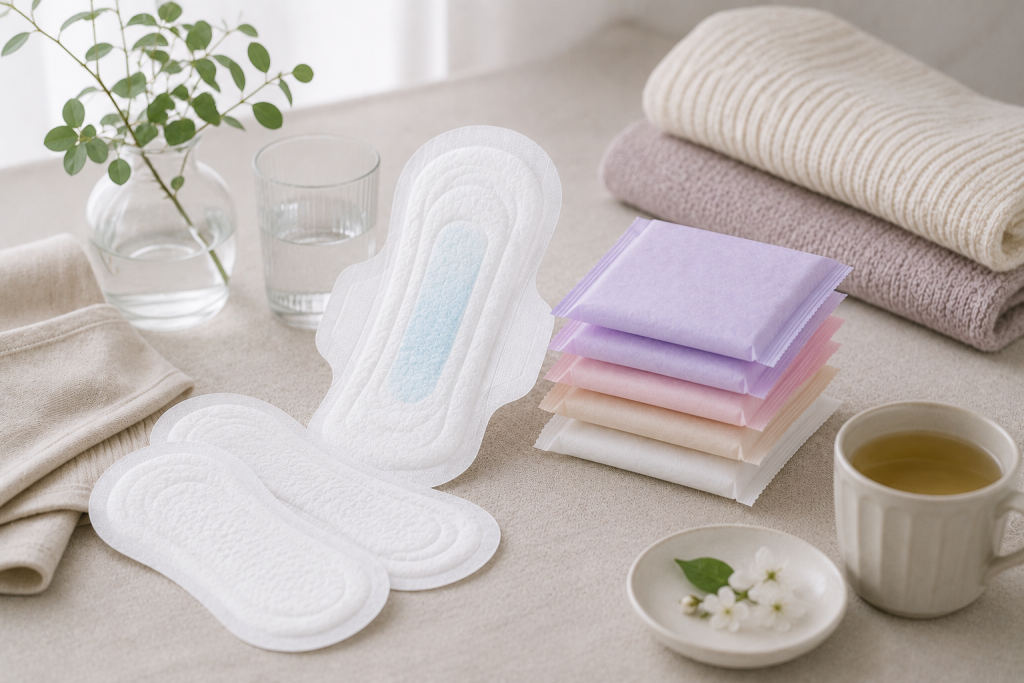
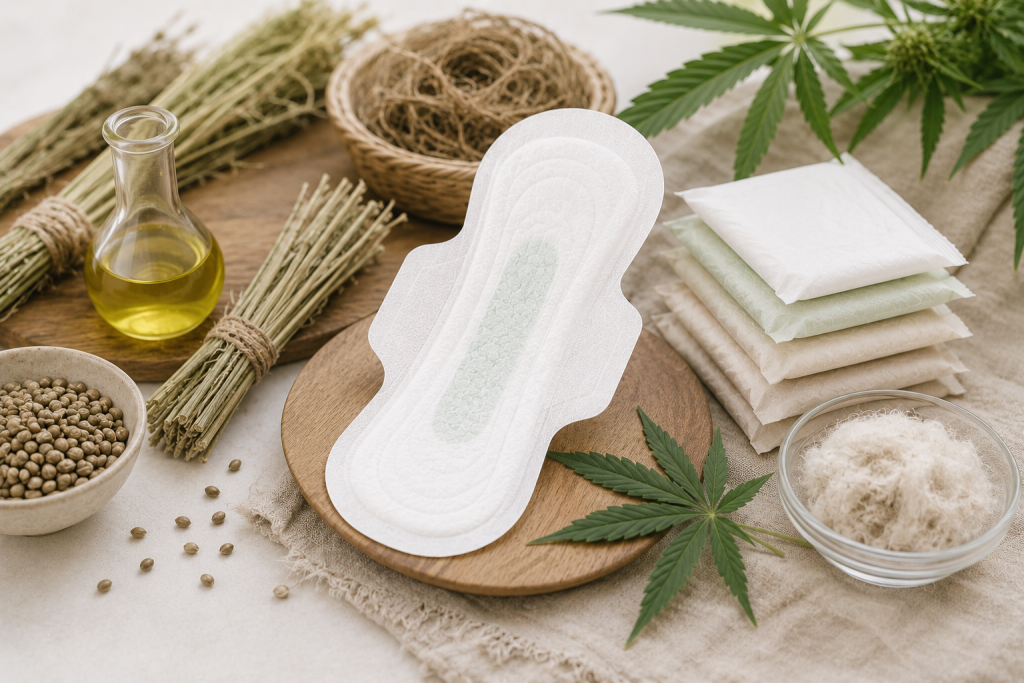
This guide is written for brand owners, distributors, and private label buyers who are evaluating sensitive-skin feminine hygiene products as a product development direction. It covers the key factors buyers need to assess — topsheet materials, product claims, chemical positioning, absorbency performance, and range fit — before starting an OEM or ODM project. It is a B2B product development guide, not a consumer product recommendation article.
Why Sensitive-Skin Positioning Matters in Feminine Hygiene
Sensitive-skin positioning has become an increasingly important product direction in feminine hygiene markets. Consumers in many markets — particularly in Europe, North America, and parts of Asia — are paying closer attention to material transparency, ingredient awareness, and product comfort. This creates a clear opportunity for private label brands that can differentiate through softer materials, cleaner claims, and more skin-friendly product construction.
For private label businesses, sensitive-skin positioning can support:
- a premium comfort-focused product line that commands a higher price point
- a softer daily-use range for consumers seeking gentler everyday products
- cleaner material messaging that builds brand trust in ingredient-aware markets
- stronger differentiation in mature sanitary pad categories where standard functional positioning is crowded
This positioning is especially effective for brands that want to go beyond size and absorbency as the primary product differentiators.
What Buyers Should Evaluate When Developing Sensitive-Skin Products
1. Topsheet Material and Surface Feel
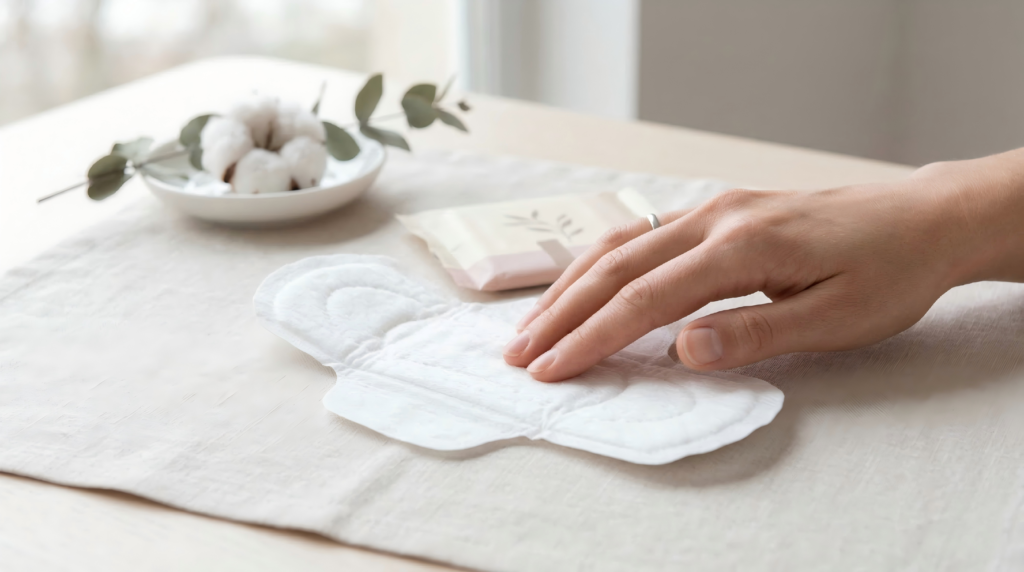
The topsheet is the layer in direct contact with the skin — making it the most important construction factor in sensitive-skin product development. Buyers should evaluate softness, smoothness, breathability, and friction reduction during daily wear. A skin-friendly topsheet should minimize irritation during extended contact, particularly for daily-use panty liner products worn outside of peak period days.
Common topsheet directions for sensitive-skin positioning:
| Topsheet Material | Surface Characteristics | Positioning Fit |
|---|---|---|
| Soft nonwoven | Smooth, good fluid transfer, standard comfort | Mainstream — suitable for standard sensitive-skin claims |
| Organic cotton | Softer surface feel, natural material, fragrance-free | Premium — strongest fit for sensitive-skin and natural positioning |
| 3D pearl topsheet | Raised surface reduces skin contact area, less friction | Comfort-focused — effective for reduced-contact positioning |
| Air-through nonwoven | Higher breathability, softer texture than standard nonwoven | Breathability-focused — supports airflow and reduced heat messaging |
Material communication on packaging should stay aligned with actual product construction. Overstated comfort claims unsupported by material choice weaken consumer trust and create compliance risk.
2. Chemical and Ingredient Positioning
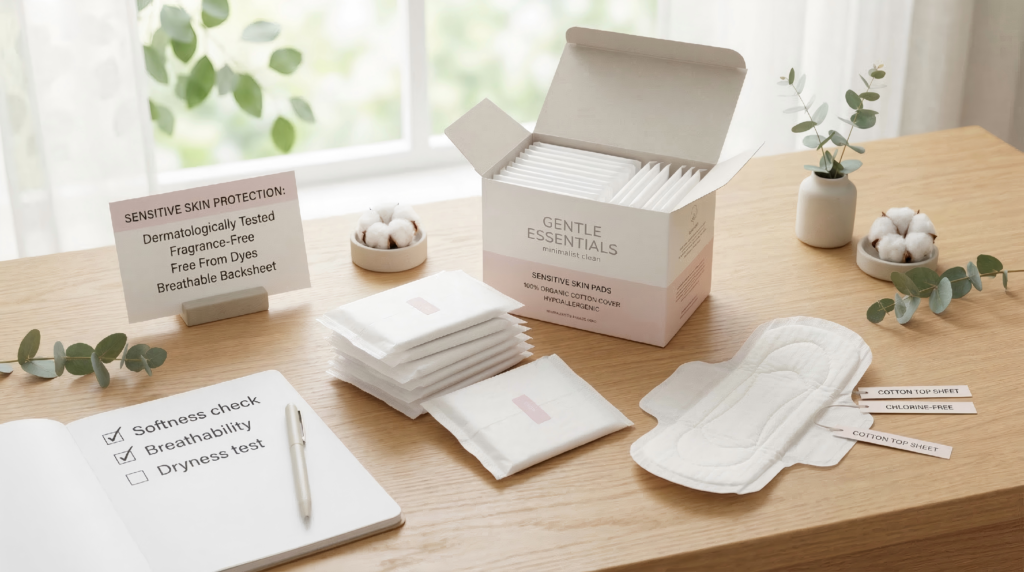
Sensitive-skin products are most credible when their cleaner positioning is supported by specific, verifiable material attributes rather than general "gentle" or "natural" marketing language. The following are the most commercially meaningful claims buyers should evaluate:
| Claim | What It Means | How to Verify |
|---|---|---|
| Fragrance-free | No synthetic or natural added scents — removes a leading cause of contact irritation | Request confirmation from manufacturer; third-party test report preferred |
| FBA-free (fluorescence-free) | No fluorescent brightening agents — associated with skin sensitivity in some users | SGS or Intertek test report confirming absence |
| Chlorine-free | No chlorine bleaching in production — reduces chemical residue risk | Manufacturing process documentation from supplier |
| Hypoallergenic | Formulated to minimize allergic reaction risk | Use carefully — requires supporting evidence; avoid as standalone unverified claim |
| Organic cotton certified | Cotton content verified as organic — GOTS or OCS certification | Request original certification documents; verify issuing body and expiry |
Each of these claims should be supported by documentation before being used in packaging or marketing materials. For a full overview of certifications relevant to feminine hygiene OEM, see our guide on what certifications matter for feminine hygiene OEM.
3. Absorbency and Comfort Balance
A sensitive-skin positioning does not replace functional performance requirements. Buyers should ensure that the product delivers both surface comfort and reliable absorbency — particularly for daily-use and medium-flow products where the pad is worn for extended periods. A product that is soft but leaks, or that leaves the surface feeling wet, cannot sustain its positioning regardless of material claims.
For private label development, this means the product specification should address both the topsheet direction for comfort and the core construction for absorbency — not one without the other.
4. Product Range Fit
Not every brand needs a full sensitive-skin line immediately. Buyers should match the sensitive-skin concept to their market maturity and distribution stage:
- Starting point — a sensitive-skin daily pad or panty liner is often the most practical first SKU; lower complexity, high daily-use relevance
- Expansion — adding overnight and heavy-flow variants once the initial SKU has market feedback
- Sub-line positioning — sensitive-skin products can work as a premium sub-line within a broader range rather than as the entire product portfolio
For SKU planning, MOQ, and order structure, see our guide on OEM sanitary pads: MOQ, packaging, and lead time explained.
How Sensitive-Skin Positioning Fits Into a Private Label Portfolio
Sensitive-skin products allow brands to create depth within their feminine hygiene range — competing on comfort, softness, and material trust rather than only on size and absorbency. This is particularly effective in markets where standard functional positioning is already crowded and consumers are actively seeking cleaner product options.
Product categories where sensitive-skin positioning works well:
| Category | Why Sensitive-Skin Positioning Works | Recommended Starting Direction |
|---|---|---|
| Daily panty liners | Worn every day — skin contact duration is highest; comfort matters most | Organic cotton or soft nonwoven, fragrance-free, FBA-free |
| Regular day pads | Core period product — sensitive-skin version expands range without adding a new category | Soft or organic cotton topsheet, chlorine-free, fragrance-free |
| Overnight pads | Extended wear during sleep — breathability and surface comfort especially relevant | Breathable backsheet, soft topsheet, reinforced leak barriers |
| Premium comfort sub-line | Positions brand above mainstream options; supports higher retail price point | Organic cotton, full certification support, premium packaging |
What Buyers Should Prepare Before Starting Development
To make manufacturer discussions more productive from the first conversation, buyers should prepare the following before making contact:
- Target market — which country or region the product will be sold in
- Product category — sanitary pads, panty liners, or both
- Preferred positioning — soft comfort, clean-care, organic, premium, or wellness-focused
- Material expectations — whether organic cotton, specific certifications, or particular claims are required
- Packaging direction and brand tone — how the product should be presented to the consumer
- Launch stage or order plan — whether this is a new brand launch, a range extension, or a product replacement
For a broader overview of how to plan and structure a private label feminine hygiene project from concept to first shipment, see our guide on how to start a private label feminine hygiene brand.
Frequently Asked Questions
Are sensitive-skin feminine hygiene products always premium products?
Not necessarily. Sensitive-skin positioning covers a range of price points. At the entry level, a fragrance-free, FBA-free standard pad with a soft nonwoven topsheet can carry a credible sensitive-skin message without premium pricing. At the higher end, organic cotton certification, premium packaging, and additional claims support a stronger premium positioning. The appropriate price tier depends on the target market and distribution channel.
Do sensitive-skin products need different absorbency structures?
No — absorbency structure is independent of sensitive-skin positioning. A sensitive-skin product uses the same core construction as a standard pad of equivalent absorbency; the differentiation is in the topsheet material, chemical claims, and positioning rather than in the absorbent core. Brand owners can develop sensitive-skin variants across all absorbency levels — daily liner, regular, heavy, and overnight — using the same core specifications as their standard range.
Which product categories are best for sensitive-skin positioning?
Daily panty liners are typically the strongest fit for sensitive-skin positioning because they are worn every day and skin contact duration is highest. Regular day pads are the second strongest fit. Overnight pads benefit from breathability and surface comfort claims given extended wear during sleep. All three categories can carry sensitive-skin messaging when the material and claim structure supports it.
Can sensitive-skin products be developed through OEM and ODM programs?
Yes — sensitive-skin feminine hygiene products are well-suited to OEM and ODM development. The key is confirming that the manufacturer can support the specific topsheet materials, chemical claims, and certification documentation that the product positioning requires. Not all manufacturers can support organic cotton certification, FBA-free verification, or chlorine-free processing documentation — confirm these capabilities explicitly before starting development.
How do I verify that a manufacturer's sensitive-skin claims are accurate?
Request specific documentation for each claim. FBA-free requires a third-party test report from SGS, Intertek, or equivalent. Organic cotton certification requires a current GOTS or OCS certificate. Fragrance-free and chlorine-free should be confirmed in writing and ideally supported by test reports. A manufacturer who cannot produce documentation for their material claims is not a reliable partner for a sensitive-skin product line where consumer trust depends on claim credibility.
Planning a Sensitive-Skin Feminine Hygiene Product Line?
Niceday supports private label buyers with sensitive-skin product development across sanitary pads and panty liners — including organic cotton topsheet options, FBA-free and fragrance-free construction as standard, and third-party tested raw materials. We supply brand owners and distributors in 54+ countries from our facility in Foshan, China, with 14 intelligent production lines and daily capacity of 9.8 million pieces.
Tell us your target market, product category, and positioning direction — our OEM team will respond with relevant material options and next steps.
Contact Our OEM Team View OEM Service Details