About This Guide
This guide is written for brand owners, importers, and distributors planning an OEM sanitary pad project who want to understand what packaging customization is possible, what decisions need to be made before production, and what to confirm with a manufacturer during the development process. It covers pack formats, materials, labeling, artwork coordination, and common packaging mistakes to avoid.
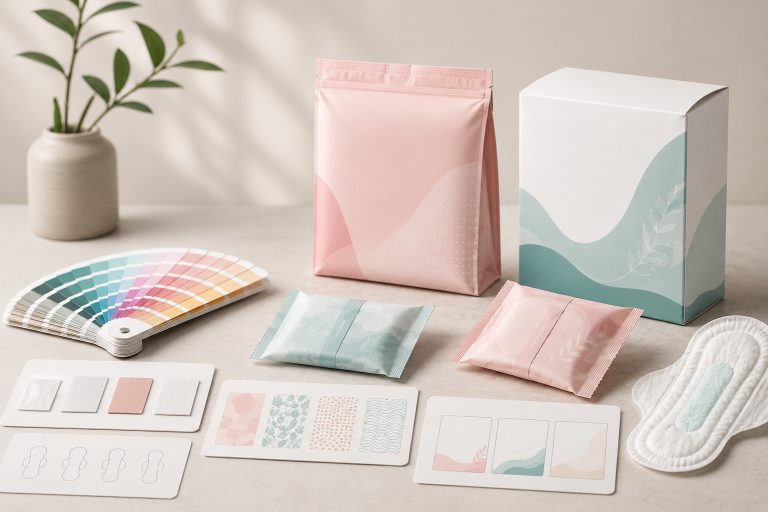
Why Packaging Matters as Much as the Product in Private Label Feminine Hygiene
In the feminine hygiene category, packaging is not a secondary consideration — it is a core part of the product offering. For private label brands, packaging is often the primary point of differentiation between competing products that share similar core construction.
Packaging affects:
- Brand perception — how professional, trustworthy, and positioned the product appears at the point of sale or on delivery
- Retail suitability — whether the product meets shelf space, display, and retail buyer requirements
- Compliance — whether labeling meets the regulatory and language requirements of the target market
- Consumer confidence — how clearly the product communicates its absorbency, material, and usage information
- Logistics efficiency — how the product ships, stacks, and stores without damage
For brand owners working with an OEM manufacturer, understanding what packaging customization is available — and what decisions need to be made before production — is essential to avoiding delays and cost overruns in the development process.
What Can Brand Owners Customize in OEM Sanitary Pad Packaging?
Most capable OEM manufacturers support a significant range of packaging customization. The following areas are typically available for discussion and adaptation in a private label project.
1. Individual Piece Wrapper
Each sanitary pad is individually wrapped before being placed into the retail pack. The individual wrapper is a direct touchpoint with the consumer and is often branded with the brand logo, a color system, or a simple pattern.
Customization options typically include:
- wrapper color and pattern
- brand logo or wordmark placement
- wrapper material (standard film or upgraded options)
- opening mechanism style
2. Retail Pack Format
The retail pack is what appears on shelves or in e-commerce listings. Pack format decisions include the number of pieces per pack, the packaging structure, and how the product is presented to the end consumer.
Common retail pack formats for sanitary pads:
| Format | Typical Use | Notes |
|---|---|---|
| Soft bag / pouch | Most common retail format globally | Cost-effective, flexible for different piece counts |
| Box / carton pack | Premium positioning, retail shelf presence | Higher packaging cost, stronger brand presentation |
| Zipper resealable pouch | Convenience positioning, e-commerce | Popular for panty liners and smaller count packs |
| Flow wrap / single piece pack | Vending, travel, sampling | Higher per-unit cost, useful for trial distribution |
| Bulk / institutional pack | Wholesale, institutional supply, donation programs | Minimal branding, lower packaging cost per unit |
3. Piece Count Per Pack
The number of pieces per retail pack affects shelf price point, consumer purchase behavior, and logistics cost. Common configurations range from 8-piece trial packs to 30+ piece value packs, depending on the product category and target market. Brand owners should confirm which piece counts the manufacturer can support within the chosen pack format.
4. Packaging Material
The material used for the outer retail pack affects cost, appearance, and sustainability positioning. Standard options include printed BOPP film for soft packs and coated paper or board for box packs. Some manufacturers can discuss upgraded or eco-oriented material options for brands with a sustainability positioning.
5. Artwork and Brand Design
The printed artwork on the retail pack — including brand logo, color system, product information, and visual design — is supplied by the brand owner as print-ready artwork files. The manufacturer adapts this to fit the packaging structure and print specifications.
What brand owners typically need to provide:
- brand logo in vector format
- color specifications (Pantone or CMYK)
- packaging design artwork prepared to the manufacturer's dieline template
- all text content including product name, usage instructions, and any regulatory copy
A capable OEM manufacturer will provide a dieline template for each packaging format and can offer basic artwork coordination support, but brand owners should have their own graphic design resource to prepare and revise artwork to the required specification.
6. Language and Regulatory Labeling
Packaging for different markets typically requires different language content and may require specific regulatory information. This includes product name and description, usage instructions, material or ingredient disclosure, manufacturer information, country of origin, and any required certification markings.
Brand owners must confirm all required labeling content for their target market before artwork finalization. Manufacturers with export experience can advise on common requirements but cannot be responsible for market-specific regulatory compliance — that responsibility rests with the brand owner and their local regulatory advisor.
7. Outer Carton Configuration
The outer shipping carton is the packaging layer that affects logistics — how the product is packed for container loading, how it stacks in a warehouse, and how it survives transit. Outer carton specifications include carton size, pieces per carton, carton marking requirements, and pallet configuration. These are practical logistics decisions that should be confirmed before production is finalized.
What Is the Packaging Development Process in an OEM Project?
Understanding the packaging development sequence helps brand owners plan their timelines realistically and avoid the delays that most commonly affect first-time OEM projects.
| Stage | What Happens | Who Is Responsible |
|---|---|---|
| 1. Format confirmation | Brand owner selects pack format, piece count, and material direction | Brand owner + manufacturer discussion |
| 2. Dieline provided | Manufacturer provides structural dieline template for the chosen format | Manufacturer |
| 3. Artwork preparation | Brand owner prepares print-ready artwork on the dieline, including all text and design elements | Brand owner (with own design resource) |
| 4. Artwork review | Manufacturer reviews artwork for print suitability and flags technical issues | Manufacturer |
| 5. Pre-production proof | Manufacturer produces a physical or digital proof for brand owner approval | Manufacturer produces, brand owner approves |
| 6. Production confirmation | Brand owner signs off on packaging; bulk production begins | Brand owner |
The most common cause of packaging delay is slow or incomplete artwork submission. Brand owners who prepare artwork in parallel with product sampling — rather than waiting until sampling is complete — can significantly reduce total development time.
Common Packaging Mistakes in OEM Sanitary Pad Projects
These are the most frequent packaging-related issues that slow down or complicate OEM projects for first-time brand owners.
- Submitting artwork in the wrong format — Packaging artwork must be print-ready vector files, not low-resolution images or PDF exports from presentation software. Confirm the manufacturer's file format requirements before starting design work.
- Missing regulatory text — Forgetting required labeling content such as manufacturer address, country of origin, or required language copy causes artwork revisions after print proofing, which adds time and cost.
- Incorrect color specification — Screen colors and print colors are different. Always specify Pantone or CMYK values for brand colors, not RGB or HEX values, to ensure consistent printed output.
- Underestimating artwork revision time — Most packaging artwork requires at least one revision round after the manufacturer's review. Build this into your timeline rather than assuming first-submission approval.
- Choosing pack format without checking MOQ impact — Different pack formats may have different MOQ implications. Confirm how pack format choice affects per-SKU MOQ before finalizing your packaging structure.
- Leaving labeling to the last stage — Regulatory labeling content for the target market should be confirmed before artwork starts, not added after the design is otherwise complete.
Frequently Asked Questions
Can I use the same packaging design for different markets?
The same visual design can often be used across markets, but the text content — including language, regulatory disclosures, and required markings — typically needs to be adapted per market. A multi-language pack is one approach, but it increases the amount of text on the packaging and may affect design presentation. Discuss this with your manufacturer during the format planning stage.
Does the manufacturer own my packaging design?
Packaging artwork created by or for the brand owner is generally owned by the brand owner. However, if the manufacturer's design team creates artwork on your behalf, ownership terms should be confirmed in writing before the project begins. Standard practice is that custom artwork developed specifically for your brand belongs to you.
How long does packaging development typically take?
From dieline receipt to approved pre-production proof, packaging development typically takes 2–4 weeks, assuming artwork is submitted promptly and revisions are kept to a minimum. This process can run in parallel with product sampling to avoid adding time to the total project timeline.
What is a dieline and why do I need one?
A dieline is a flat technical template showing the exact dimensions and fold lines of a packaging structure. It is the file your graphic designer uses as the base when creating packaging artwork. Your manufacturer provides the dieline for the specific pack format you have chosen. Working from the manufacturer's dieline ensures your artwork fits correctly when the packaging is printed and assembled.
Can the manufacturer help with packaging design if I don't have a designer?
Some OEM manufacturers offer basic design coordination support, but this varies significantly by supplier. If you do not have access to a graphic designer, confirm what support the manufacturer can provide before committing to the project timeline. Having your own design resource is the more reliable approach for maintaining control over brand consistency and revision speed.
What is the minimum piece count per retail pack?
Minimum piece count per retail pack depends on the product category, pack format, and manufacturer. For sanitary pads, common retail configurations start from 8 pieces for smaller packs up to 30+ pieces for value formats. Discuss your target retail price point and market expectations with the manufacturer — they can advise on which configurations are most practical within the production and MOQ structure.
Discussing Packaging Options for Your OEM Project?
Niceday supports private label brand owners with packaging customization across sanitary pads, panty liners, menstrual pants, and related feminine hygiene categories. We provide dieline templates, coordinate artwork review, and advise on format and material options based on your target market and product positioning.
Tell us your product category, target market, and packaging direction — our OEM team will respond with relevant options and next steps.
Contact Our OEM Team View OEM Service Details