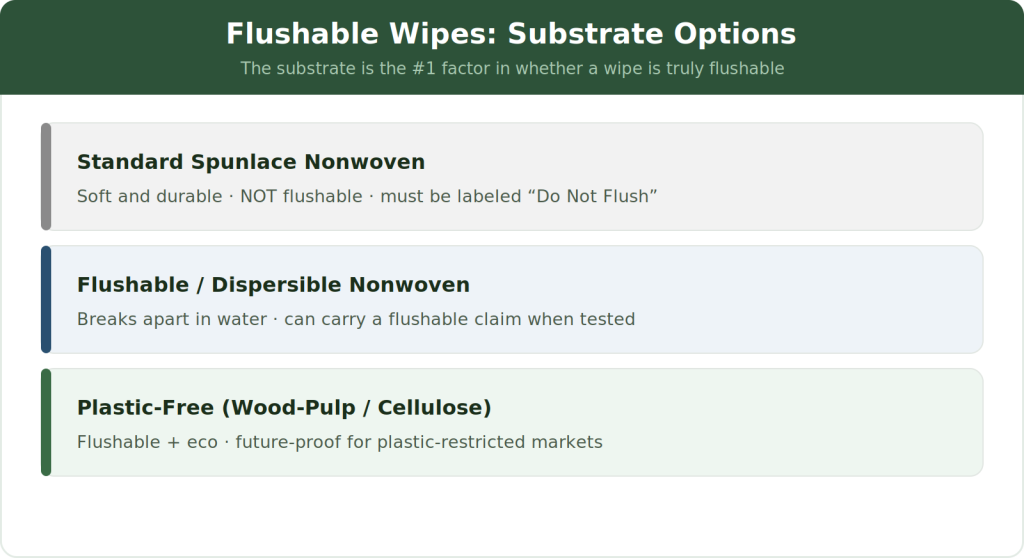
For brand owners, importers, and private label buyers, sourcing flushable wipes comes down to three decisions: the substrate (the nonwoven material), the flushability standard the product is tested against, and the labeling rules in each market you sell to. Get these three right and "flushable" becomes a safe, sellable claim. Get them wrong and you risk blocked shipments, retailer rejection, or misleading-claim complaints. This guide explains each decision in plain terms.
What does "flushable" actually mean?
A flushable wipe is intended for disposal through standard toilet systems. "Dispersible" describes how quickly and fully the wipe breaks apart in water. True flushability depends on the substrate and on testing against recognized standards — not on the word "flushable" printed on the pack.
This matters because most wet wipes are not flushable. Standard wet wipes use a durable spunlace or plastic-based nonwoven that does not break down in sewer systems. Only wipes built on a special dispersible substrate should ever carry a flushable claim.
Decision 1: Choose the right substrate
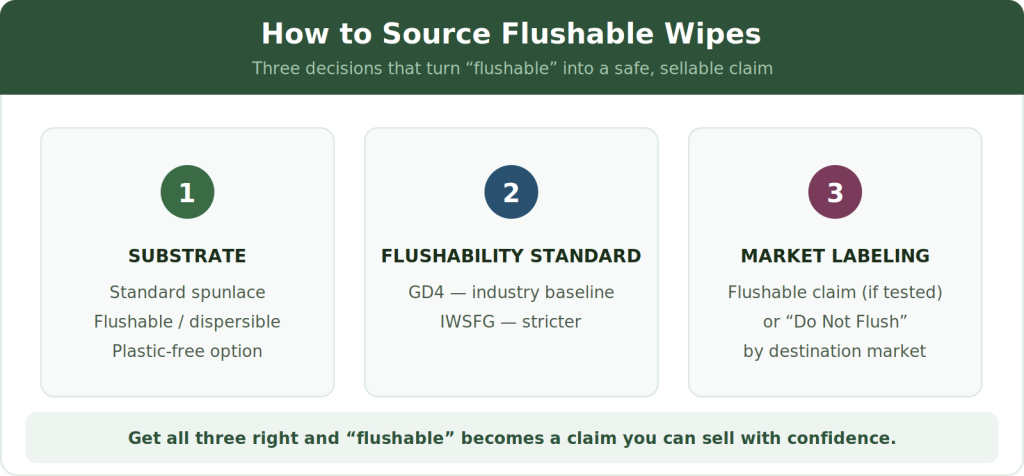
The substrate is the single biggest factor in whether a wipe is truly flushable and how it can be positioned. Three common options:
- Standard spunlace nonwoven — soft and durable, but not flushable. These SKUs must be labeled "Do Not Flush."
- Flushable / dispersible nonwoven — designed to break apart in water after use.
- Plastic-free, wood-pulp / cellulose-based — flushable plus an eco-friendly positioning, and increasingly necessary as markets restrict plastic in wipes.
Plastic-free substrate is becoming more important, not less. Several markets are moving against plastic in wet wipes — the UK, for example, is banning the supply of wet wipes containing plastic, with the rules taking effect around 2027. Choosing a plastic-free dispersible substrate helps future-proof your product against these changes.
Decision 2: Match the flushability standard (IWSFG vs GD4)
Professional buyers and retailers increasingly ask which standard a wipe is tested against. The two you will hear most often:
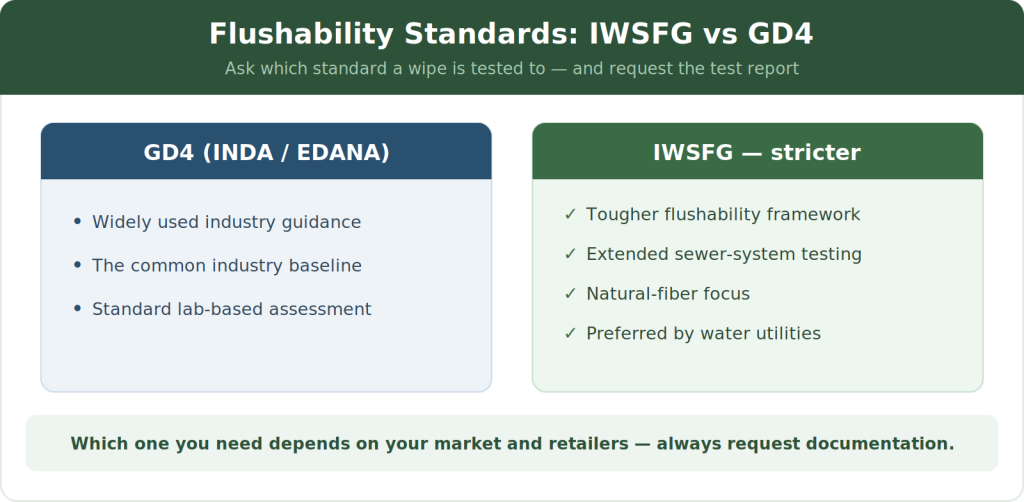
Which standard you need depends on your market and your retailers. The practical step is the same in every case: ask the manufacturer which standard the product is tested to, and request the matching test documentation before you commit to an order.
Decision 3: Get the market labeling right
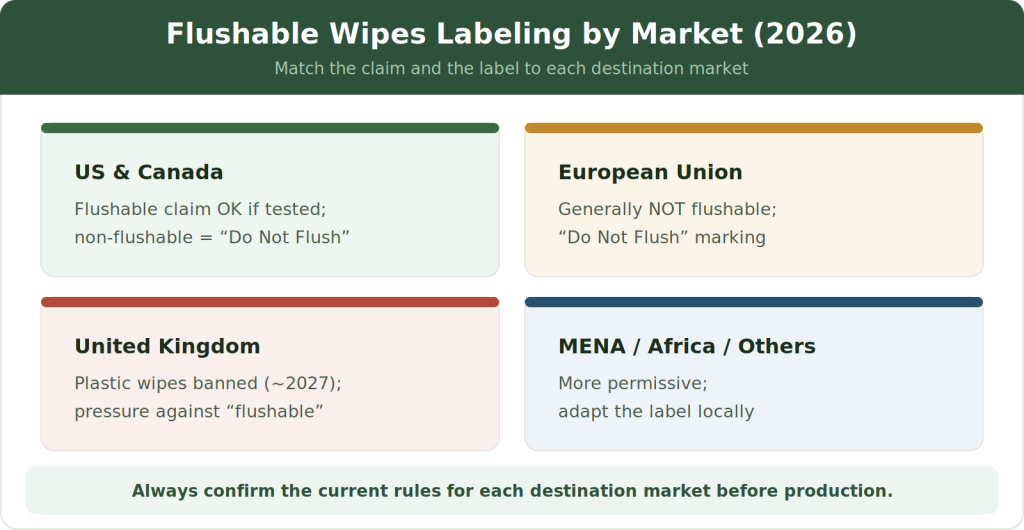
Labeling rules differ by market and are tightening. The following reflects the situation as of 2026 — always confirm the current requirements for your destination market before production:
- United States & Canada: flushable claims are generally accepted when supported by testing. Non-flushable wipes must carry a clear "Do Not Flush" symbol, in line with current US labeling requirements (several states already mandate this).
- European Union: wet wipes are generally labeled as not flushable, with a "Do Not Flush" marking under single-use plastics rules.
- United Kingdom: plastic-containing wet wipes are being banned (around 2027), and there is strong regulatory pressure against "flushable" and "disposable" labeling.
- Middle East, Africa, and other markets: generally more permissive — adapt packaging language and claims to local expectations.
The takeaway: match the claim and the label to each destination market. A compliant label is not a limitation — it protects your brand and keeps your shipments moving.
Sourcing checklist: what to ask a flushable wipes manufacturer
Before you select a supplier, ask:
- Is this an own factory or a trading company? An own-factory flushable wipes manufacturer gives you more control over substrate, quality, and timelines.
- Which substrate options are available? Is there a plastic-free / dispersible option?
- Which flushability standard — IWSFG or GD4 — and can you provide test reports?
- Can you provide "Do Not Flush" labeling for non-flushable SKUs?
- What are the MOQ, lead time, and packaging customization options?
- Can you adapt labeling and claims by destination market?
- Are INCI lists and export documentation provided?
Common mistakes when sourcing flushable wipes
- Treating "flushable" as a marketing word instead of a tested property.
- Choosing a plastic substrate for a market that is moving toward plastic-free.
- Using one label for every market instead of adapting per destination.
- Ordering without asking for flushability test documentation.
- Assuming all "moist toilet tissue" is automatically flushable — it depends on the substrate.
Frequently asked questions
Are all wet wipes flushable?
No. Most wet wipes use a durable, non-flushable substrate and should be labeled "Do Not Flush." Only wipes built on a dispersible substrate and tested against a recognized standard should carry a flushable claim.
What is the difference between flushable and dispersible wipes?
Flushable means the wipe is intended for disposal through standard toilet systems. Dispersible describes how quickly and fully it breaks apart in water. Dispersibility is the property being tested behind a flushable claim.
Which standard is stricter, IWSFG or GD4?
IWSFG is generally regarded as the stricter framework, based on extended sewer-system testing and natural-fiber requirements. GD4 (INDA/EDANA) is the common industry baseline.
Can flushable wipes be plastic-free?
Yes. A flushable, dispersible substrate can be made from wood-pulp / cellulose-based materials, giving you both flushability and a plastic-free positioning — useful for markets restricting plastic in wipes.
Do I need different labels for different markets?
Usually yes. Flushable claims and "Do Not Flush" requirements vary by market, so the label should be adapted to each destination.
Source flushable wipes with confidence
Niceday is an own-factory manufacturer of flushable and dispersible wipes, with plastic-free substrate options, IWSFG / GD4 reference testing, and market-compliant labeling support. Explore our full women's personal care wet wipes range or OEM & ODM service, and talk to our OEM consultants to discuss your private label flushable wipes project.