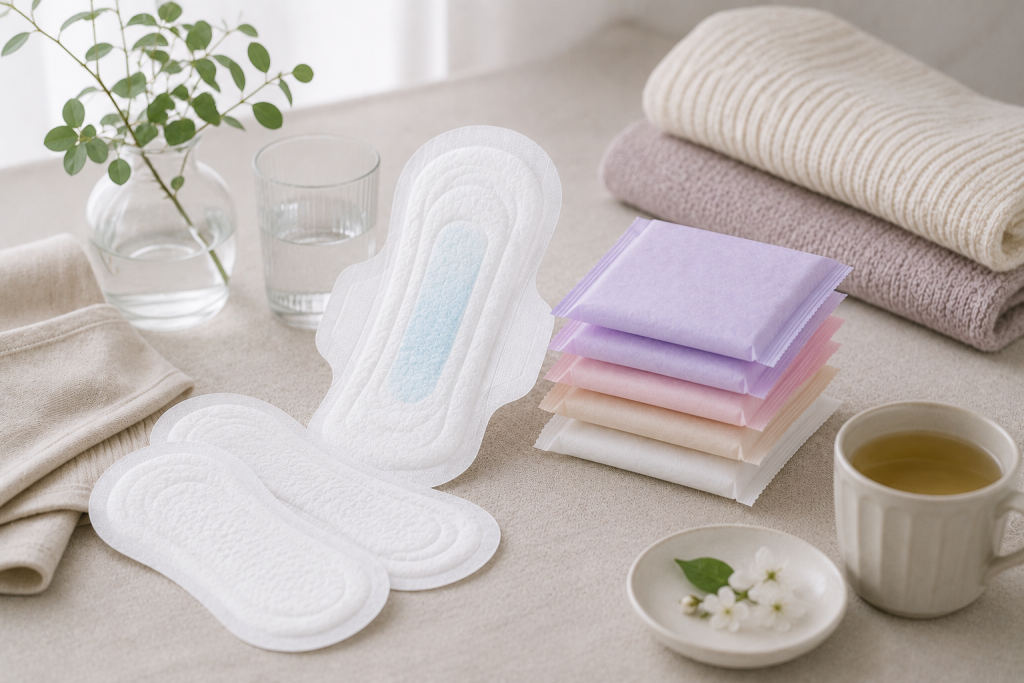
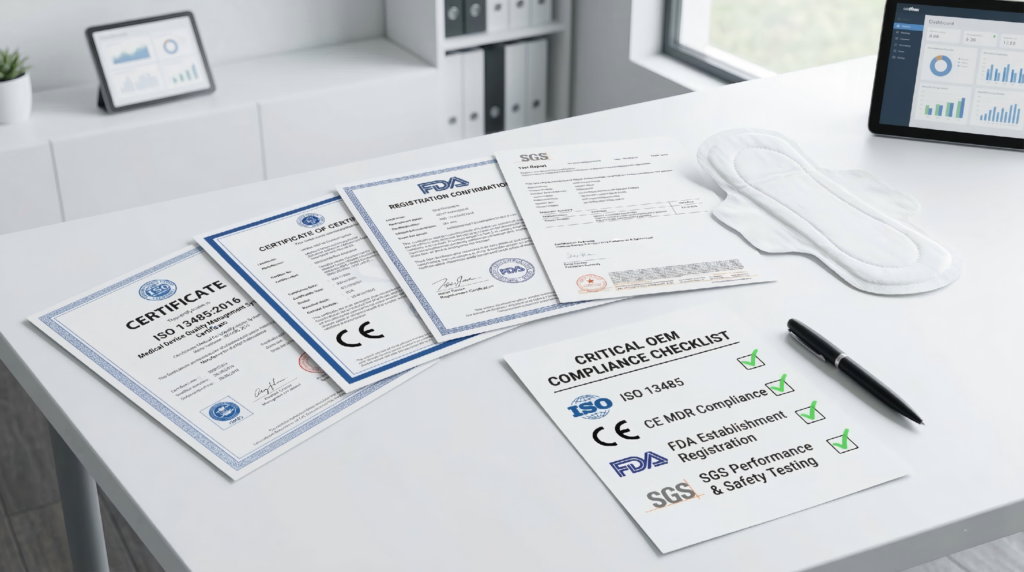
When evaluating an OEM partner for feminine hygiene products, buyers should distinguish between quality management certifications, regulatory compliance requirements, and market-entry documentation. These are related, but they are not the same thing. A more accurate understanding helps private label brands, distributors, and OEM buyers assess suppliers more professionally and reduce compliance misunderstandings across different markets.
For feminine hygiene OEM projects, certifications and compliance signals do more than support product claims. They can also affect buyer confidence, market access, retail acceptance, and long-term brand credibility. This is why compliance should be treated as part of product development and market planning, not as a final checklist item.
For a broader overview of how supplier capability, quality systems, and project execution fit into OEM decision-making, see How to Choose a Private Label Sanitary Pad Manufacturer. For practical planning factors related to order setup and launch timing, see OEM Sanitary Pads: MOQ, Packaging & Lead Time Explained.
Why Certifications and Compliance Matter in Feminine Hygiene OEM
In private label feminine hygiene development, buyers are not only choosing a product. They are also choosing a manufacturing system and a market-entry pathway. Certifications and compliance documents can help buyers:
- evaluate supplier discipline and quality management
- reduce regulatory risk in target markets
- support retailer and distributor confidence
- align product claims with acceptable documentation
- avoid delays caused by incomplete compliance planning
The key point is that not every market uses the same compliance logic. Some requirements are based on quality management systems, some are based on chemical or labeling laws, and some are based on sanitary registration or conformity assessment procedures.
A professional OEM partner should be able to explain which route is relevant to the specific project.
ISO 9001 — Quality Management System
ISO 9001 is an internationally recognized quality management standard. It shows that a manufacturing partner has established processes for quality planning, control, and continuous improvement.
For buyers, ISO 9001 is best understood as a quality management system signal, not as proof of market-specific product approval. It helps show that the supplier has a structured approach to managing quality across production.
What ISO 9001 can signal to buyers
- quality procedures are standardized
- production consistency is documented
- internal improvement mechanisms are in place
- the factory has a more structured management approach
For a wider view of how factory capability and quality systems affect OEM selection, see How to Choose a Private Label Sanitary Pad Manufacturer.
U.S. FDA Regulatory Requirements
For the United States market, buyers should verify the applicable FDA regulatory requirements for feminine hygiene products such as menstrual pads and tampons.
A safer and more professional way to describe this on a B2B website is to say that buyers should confirm the relevant FDA obligations with their manufacturer or regulatory advisor, including product classification, labeling, and any applicable premarket requirements. This is more accurate than implying there is one universal FDA certificate for all feminine hygiene products.
What buyers should verify for the U.S. market
- whether the product falls under an FDA-regulated category
- whether a 510(k) pathway applies
- labeling and claims requirements
- applicable quality-system-related expectations
- importer and registration responsibilities where relevant
For buyers targeting the U.S., this should be discussed early rather than after packaging is finalized. For practical launch planning, timing, and documentation coordination, see OEM Sanitary Pads: MOQ, Packaging & Lead Time Explained.
EU Regulatory and Chemical Compliance
For European Union markets, buyers should confirm the applicable product safety, labeling, and chemical compliance requirements for feminine hygiene products. One of the most important frameworks is REACH, the main EU law governing chemicals and the risks they may pose to human health and the environment.
For website wording, it is safer to describe this as EU regulatory and chemical compliance rather than stating that all feminine hygiene products require one universal EU certification. Depending on the product, materials, and claims, compliance may involve chemical restrictions, labeling obligations, and market-specific documentation.
What buyers should verify for EU markets
- chemical compliance requirements such as REACH
- applicable labeling obligations
- material-related restrictions or declarations
- any environmental or packaging-related marking requirements
- whether product claims trigger additional compliance review
This is a more accurate and future-proof approach than relying on a blanket “CE marking” statement.
If your EU project also involves organic or eco-positioned products, it is useful to align compliance review with material storytelling and packaging claims from the start.

Russia / EAEU Sanitary and Conformity Requirements
For Russia and other EAEU markets, buyers should verify the applicable sanitary and conformity route before launch. Depending on product classification, claims, and import arrangements, feminine hygiene products may require a State Registration Certificate (SGR) as part of sanitary-hygienic market access, along with applicable EAEU conformity procedures or other local documentation.
This is why it is safer to write Russia / EAEU sanitary and conformity requirements rather than making a blanket statement that all such products simply require “GOST certification.”
What buyers should verify for Russia / EAEU
- whether the product requires SGR
- whether EAEU conformity procedures also apply
- what classification the importer or certification body uses
- whether the product claims affect the route
- what local documentation is needed for customs and distribution
If your target market includes Russia or other EAEU countries, your manufacturer or certification partner should be able to explain whether the project requires SGR, EAEU conformity procedures, or other local compliance documents. Buyers can also review supplier capability and project coordination expectations in How to Choose a Private Label Sanitary Pad Manufacturer.
Optional Organic or Eco-Focused Certifications
For brands positioned around sustainability, organic materials, or premium natural concepts, optional certifications or audited schemes can help support product claims and strengthen brand credibility. These may include textile-related organic or ecological programs associated with standards such as Organic Content Standard (OCS), Global Organic Textile Standard (GOTS), or relevant ECOCERT-supported certification schemes, depending on the material story behind the product.
These certifications are generally more relevant for brand positioning and claim support than for basic market access. They are especially useful when the private label product is marketed around organic cotton, sustainability, or environmentally conscious consumer values.
When these certifications are most useful
- the product emphasizes organic cotton or natural materials
- the brand needs stronger sustainability storytelling
- the target customer is more eco-conscious
- the packaging and claim strategy are built around premium natural positioning
For these projects, buyers should make sure the claim language and the supporting documentation stay aligned. If your organic positioning is part of a broader category strategy, related product planning can also be supported through How to Choose a Private Label Sanitary Pad Manufacturer
Other Relevant Compliance Signals
Depending on the product and target market, buyers may also evaluate:
- OEKO-TEX STANDARD 100 for harmful-substance testing in textile-related components
- REACH for EU chemical compliance
- applicable quality-system controls or device-related regulatory pathways in markets such as the United States
The key point for private label buyers is to confirm which items are true certifications, which are regulatory compliance obligations, and which are part of a market-entry procedure. This distinction improves decision-making and helps avoid inaccurate compliance claims in product development and sales communication.
Common Buyer Questions About Certifications
There is no single universal answer. The most relevant requirement depends on the target market, product classification, and claim strategy. In many cases, buyers look first at overall quality management systems such as ISO 9001, and then confirm the applicable regulatory requirements for the destination market.
Not necessarily. For the U.S. market, buyers should confirm the exact FDA regulatory pathway that applies to their product, including any relevant labeling or premarket requirements. It is safer to describe this as FDA regulatory compliance rather than “FDA certification.”
Buyers should verify the exact compliance requirements for their specific product and claims. For many feminine hygiene products, it is more accurate to focus on applicable EU regulatory, labeling, and chemical compliance requirements, including frameworks such as REACH, rather than assume one universal certification applies to all products.
It can be. For Russia and other EAEU markets, buyers should verify whether their product requires SGR, EAEU conformity procedures, or other local compliance documentation, depending on classification, claims, and import setup.
Not always. Organic or eco-focused certifications are usually relevant when the product makes organic, natural, or sustainability-based claims. In those cases, the documentation should match the product story and material profile.
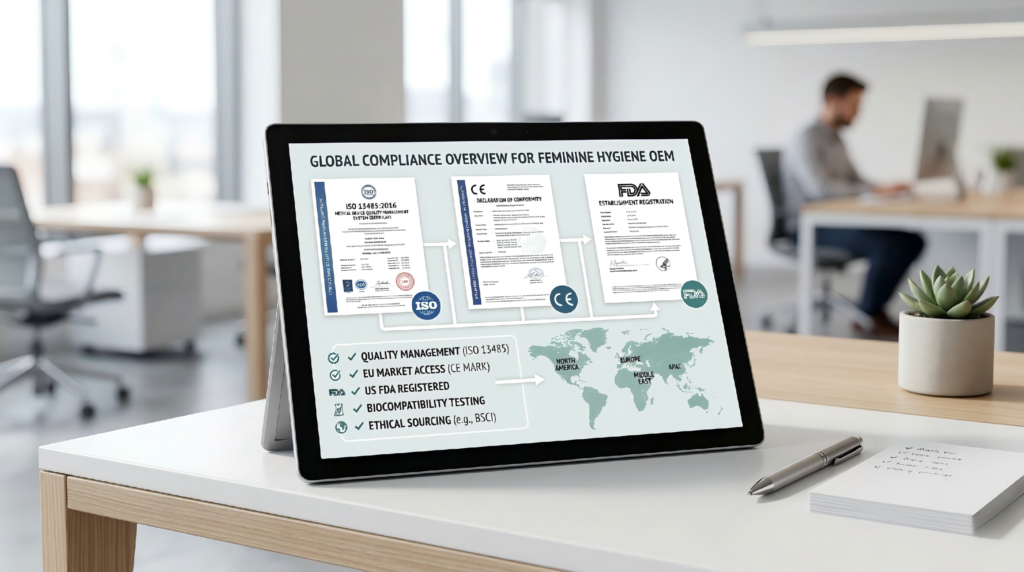
What Buyers Should Prepare Before Discussing Certifications with a Manufacturer
To make compliance discussions more productive, buyers should prepare:
- target market or region
- product category and positioning
- expected certification or compliance requirements
- labeling and claims strategy
- material and ingredient expectations
- packaging type and claim wording
- order volume expectations
This preparation helps the OEM partner provide more accurate feedback, compliance guidance, and project feasibility assessment.
Conclusion
Certifications and compliance requirements are more than formal checkboxes. They signal quality, safety, and market readiness to regulators, importers, retailers, and buyers. For private label feminine hygiene projects, the most professional approach is to evaluate compliance based on the target market, product category, material profile, and claim strategy.
A capable OEM partner should be able to explain which quality systems, regulatory requirements, and market-entry documents are relevant to the project, and where additional third-party compliance support may be needed.
Looking for Private Label Sanitary Pad OEM / ODM Support?
At Niceday, we do more than support product development. We also help buyers navigate certification and compliance planning by working closely with testing institutions, documentation partners, and project teams, so the OEM process stays better aligned with the requirements of different target markets.
If you are planning a private label feminine hygiene project, you can also explore our OEM & ODM Service or contact Niceday to discuss your project directly.