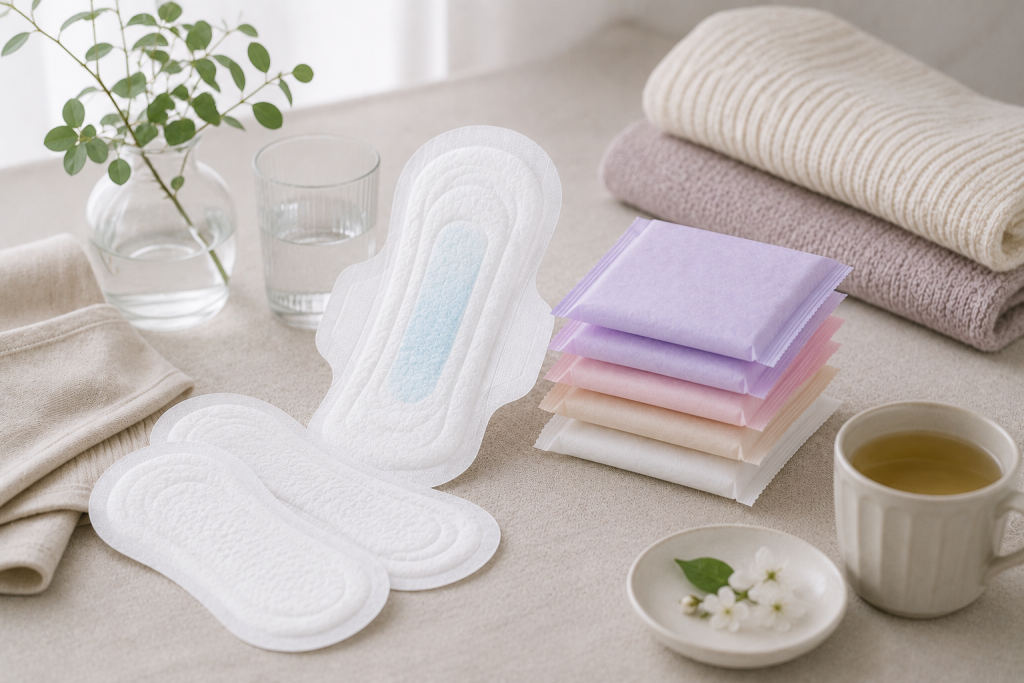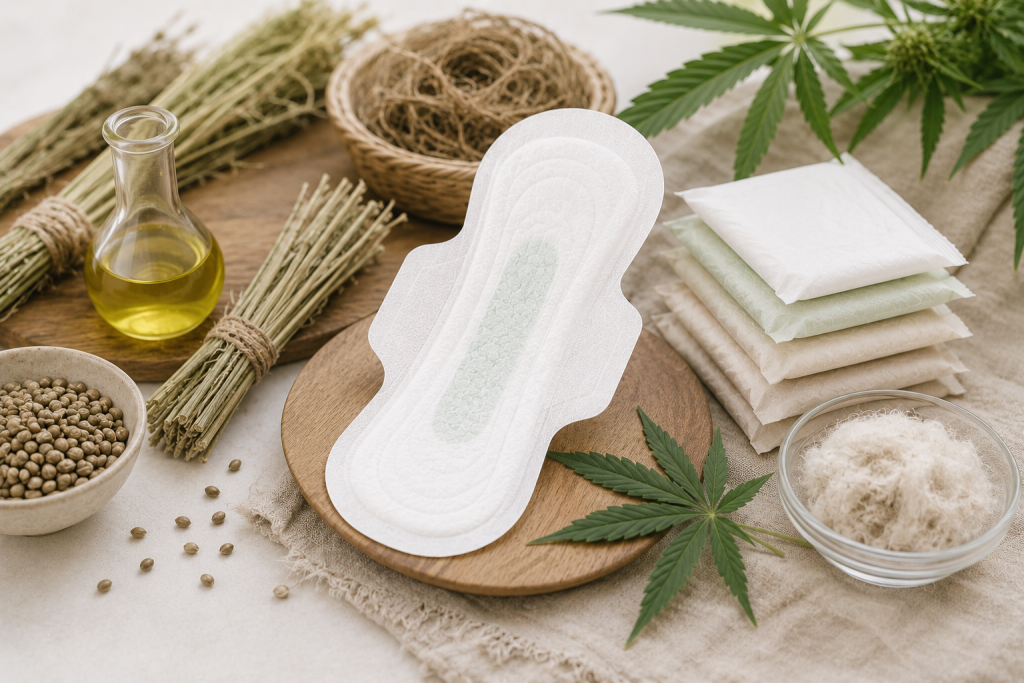
Sanitary pads are everyday essentials used by over 2 billion women worldwide, yet few people know how they are actually made. Behind every comfortable, leak-proof pad is a precise multi-stage manufacturing process that combines automated machinery, food-grade raw materials, and strict quality control.
This guide walks you through exactly how sanitary pads are manufactured inside a modern women napkins factory — from raw material preparation to final packaging. Whether you are a brand owner evaluating OEM suppliers or a distributor researching product quality, this article gives you the complete picture.
Quick links: OEM & ODM Service → | Sanitary Pad Catalog → | Request Sample → | WhatsApp →
What Is a Women Napkins Factory?
A women napkins factory is a specialized manufacturing facility that produces disposable sanitary pads at industrial scale. These factories operate automated high-speed production lines that combine multiple layers of absorbent, protective, and surface materials into a single finished pad, ready for packaging and shipment.
A professional sanitary pads factory is responsible for four core functions:
- Material sourcing — Selecting and verifying raw materials that meet safety and performance standards
- Production — Running automated lines that shape, layer, and assemble pads at speeds of up to 800 pieces per minute
- Quality control — Inspecting every batch at multiple checkpoints to ensure consistency and compliance
- Packaging — Individual wrapping, box packing, and labeling ready for retail or private label branding
The difference between a small workshop and a professional factory lies in three things: clean room standards, production automation, and certification compliance — all of which directly affect the final product’s safety and quality.
The Sanitary Pads Manufacturing Process: 7 Key Steps
Modern sanitary pads are made through a fully automated process that takes raw materials from storage to finished, individually wrapped products in under 2 seconds per piece. Here are the seven main stages:
Step 1 — Raw Material Preparation
All raw materials are inspected and prepared before entering the production line:
- Top sheet materials — Non-woven fabric, organic cotton, or cotton-blend fabric
- Absorbent core materials — Fluff pulp, super absorbent polymer (SAP), and airlaid paper
- Back sheet materials — PE film (polyethylene) for leak prevention
- Adhesive and release paper — Food-grade adhesive for wing wrap and positioning
In certified factories, all raw materials must pass incoming quality inspection (IQC) including fiber composition tests, absorbency verification, and safety checks for fluorescent brightening agents (FBA).
Step 2 — Absorbent Core Forming
The absorbent core is the heart of every sanitary pad. Fluff pulp is combined with SAP granules and compressed into a rectangular or hourglass-shaped core. The ratio of pulp to SAP determines the pad’s absorbency level — typically ranging from 5ml (liner) to 300ml (overnight super+).
Some premium pads, such as organic cotton pads or biodegradable pads, use modified core structures — for example, a sushi-structure organic cotton core or a double-layer wood pulp core.
Step 3 — Layer Assembly and Lamination
The automated line brings together multiple layers in precise sequence:
- Top sheet (user-facing layer)
- Airlaid or tissue paper (diffusion layer)
- Absorbent core (SAP + pulp)
- Back sheet (PE film)
- Adhesive application (wings and central strip)
For functional products, additional layers such as herbal chips, anion chips, graphene chips, or negative ion chips are inserted between the top sheet and airlaid paper during this stage.
Step 4 — Shaping and Embossing
The laminated pad is shaped into its final contour — including side leak guards, embossed channels, and wing cut-outs. Standard lengths include 155mm (daily liner), 245mm (regular), 285mm (large), 330mm (overnight), 360mm (extra-long), and 420mm (super overnight).
The embossing pattern serves both aesthetic and functional purposes: it directs fluid flow toward the center of the core and prevents back-flow.
Step 5 — Cutting and Folding
Each pad is cut to exact dimensions and folded into its individual wrapper. Modern production lines perform this step at speeds of 600–800 pads per minute with less than 0.5% waste.
Step 6 — Individual Wrapping
Each pad is individually wrapped in a PE, non-woven, or biodegradable PLA film wrapper. The wrapper is sealed, printed with branding or batch codes, and prepared for bag or box packaging.
Step 7 — Final Packaging and Inspection
Individual wrapped pads are grouped into retail packs (commonly 8, 10, 12, or 16 pieces per pack), then packed into outer cartons for shipment. Before sealing, each batch undergoes final quality inspection (FQC) including:
- Visual defect check
- Random absorbency testing
- Packaging integrity verification
- Lot code and expiration date confirmation
Raw Materials Used in Sanitary Pads Manufacturing
The quality of a sanitary pad is directly determined by the quality of its raw materials. Professional factories source from internationally recognized suppliers to ensure consistency and safety:
| Component | Material | Function |
|---|---|---|
| Top sheet | Non-woven fabric, organic cotton, cotton-blend | Skin contact surface; breathability and softness |
| Diffusion layer | Airlaid paper, tissue paper | Spreads fluid across the core |
| Absorbent core | Fluff pulp + SAP (super absorbent polymer) | Holds and locks liquid |
| Back sheet | PE film or biodegradable PLA | Prevents leaks |
| Adhesive | Food-grade hot-melt adhesive | Secures pad to underwear |
| Release paper | Silicone-coated paper | Protects adhesive before use |
| Optional chips | Anion chip, herbal chip, graphene chip, negative ion chip | Adds functional benefits |
Factories with strong supplier partnerships — such as Henkel (adhesives), 3M, International Paper (fluff pulp), and Sumitomo or Nippon Shokubai (SAP) — can consistently deliver higher quality than factories using unverified local materials.
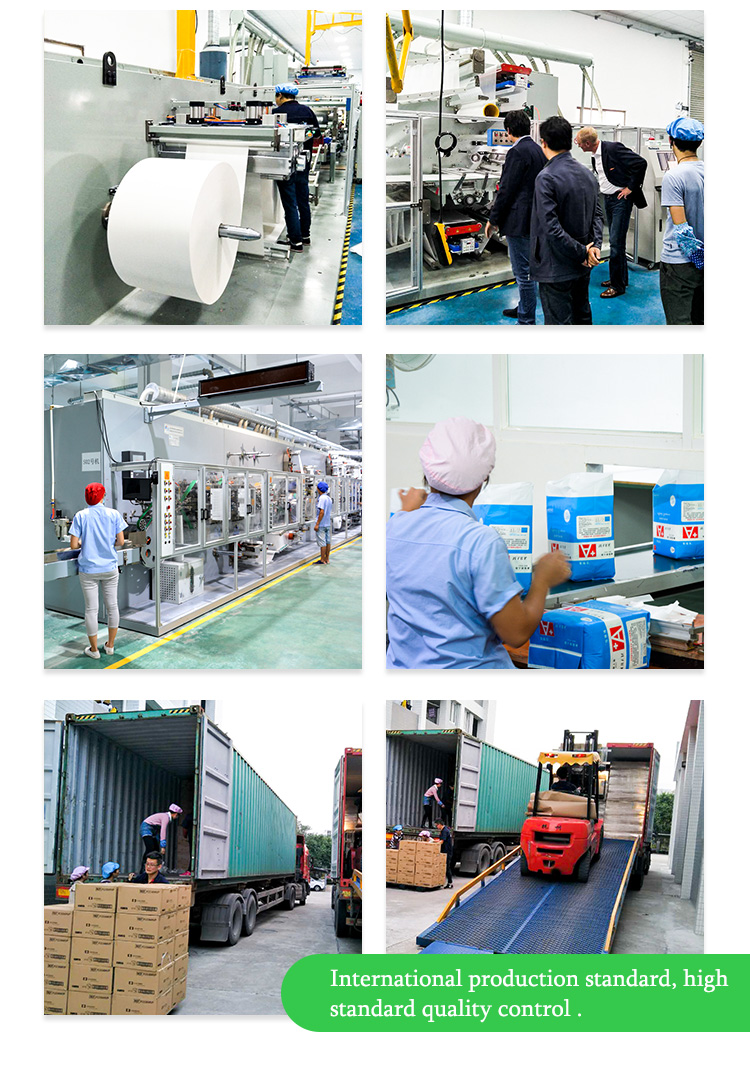
Key Equipment and Clean Room Standards
Sanitary pads are considered personal care products that contact sensitive skin, which means manufacturing environment matters just as much as the materials themselves.
A professional women napkins factory operates under these standards:
- 100,000-level clean room — Controlled airborne particle count, temperature, and humidity
- Automated production lines — High-speed equipment with minimal human contact
- Closed material handling — Raw materials are transferred through enclosed systems
- Staff hygiene protocols — Workers wear full clean-room attire; hand-washing and air showers before entering production zones
Factories without proper clean room standards risk bacterial contamination, inconsistent quality, and failed compliance audits in export markets.
Quality Control: What Separates a Good Factory from a Great One
Quality control in sanitary pads manufacturing is not a one-time check — it happens at every stage of production. A professional factory performs:
- Incoming Quality Control (IQC) — Inspection of all raw materials before they enter production
- In-Process Quality Control (IPQC) — Real-time checks during production for weight, dimensions, absorbency, and visual defects
- Final Quality Control (FQC) — Random sampling from finished batches for absorbency tests, pH tests, and packaging integrity
- Outgoing Quality Control (OQC) — Pre-shipment inspection before goods leave the warehouse
Required certifications for export markets typically include FDA (United States), CE (European Union), GOST (Russia), ISO 9001, and ISO 13485. Third-party test reports from SGS or Intertek provide additional verification for distributors and buyers.
What to Look for When Choosing a Sanitary Pads Manufacturer
If you are a brand owner or distributor evaluating a sanitary pads factory, these are the key indicators of a reliable partner:
- Factory size and capacity — Minimum 10,000 m² with automated production lines
- Clean room certification — At least 100,000-level clean room standard
- Production capacity — Daily output of at least 1 million pieces for stable supply
- Certification compliance — FDA, CE, ISO, and target market-specific certifications
- Raw material partners — Known international suppliers for critical components
- Customization capability — Ability to adapt materials, sizes, packaging, and branding
- MOQ flexibility — Reasonable minimum order quantities (typically 300,000 pcs per SKU)
- Lead time transparency — Clear timelines for sampling (7–15 days) and mass production (35–40 days)
- Quality documentation — Available SGS / Intertek reports and batch traceability
- Export experience — Proven track record across multiple countries
Inside the Niceday Factory
Niceday operates a 20,000 m² ISO-certified factory in Foshan, China, equipped with 14 automated intelligent production lines and a daily capacity of 2.8 million pieces. Our facility meets all international manufacturing standards for feminine hygiene products.
Our manufacturing strengths include:
- 100,000-level clean room across all production zones
- FDA, CE, GOST compliant products, available with SGS and Intertek test reports
- FBA-free manufacturing — no fluorescent brightening agents in any product
- Internationally sourced materials from Henkel, 3M, PGI, International Paper, OJI Kinocloth, Sumitomo, Chisso, Nippon Shokubai, and SPD
- Full OEM/ODM customization — size, materials, absorbency, functional chips, packaging, and private label branding
- Export experience across 54+ countries
We manufacture a full range of sanitary pad categories including ultra-thin daily pads, anion chip pads, herbal pads, organic cotton pads, biodegradable pads, sports pads, and teens pads.
Frequently Asked Questions
From raw material loading to finished packaging, a single sanitary pad takes approximately 2 seconds on a modern automated line. A full production order (from order confirmation to ready-to-ship) typically takes 35 to 40 days, including material sourcing, production scheduling, manufacturing, and quality inspection.
The main raw materials are non-woven fabric or cotton top sheet, fluff pulp, super absorbent polymer (SAP), PE back sheet film, food-grade adhesive, and release paper. Functional pads may also include herbal chips, anion chips, or graphene chips.
Professional factories ensure safety through clean room production, certified raw materials, multi-stage quality control (IQC, IPQC, FQC, OQC), third-party testing (SGS, Intertek), and compliance with FDA, CE, and GOST standards. Factories that manufacture without fluorescent brightening agents (FBA-free) provide an additional level of safety assurance.
MOQ varies by manufacturer, but for most professional factories, the standard minimum is 300,000 pieces per SKU. Some manufacturers offer flexible MOQ for new cooperation or market testing. Contact the manufacturer directly to discuss your specific project.
Yes. OEM/ODM manufacturers customize nearly every aspect of a sanitary pad including size (155mm to 420mm), absorbency level, top sheet material (organic cotton, bamboo, silk, hemp), functional chips, packaging format, and private label branding. Learn more about our OEM service →
OEM (Original Equipment Manufacturing) means the factory produces pads according to the buyer’s specifications and design. ODM (Original Design Manufacturing) means the factory provides its own product designs, which the buyer can adopt or modify under their own brand. Most professional factories offer both services.
Request the following documentation: business license, factory photos and video tour, ISO / FDA / CE certificates, SGS or Intertek test reports for the specific product you are sourcing, and references from existing customers. Reputable factories welcome factory visits and third-party audits.
Ready to Start Your Sanitary Pads Project?
Whether you are launching a new feminine hygiene brand, expanding an existing product line, or looking to switch manufacturers, Niceday is ready to support your project with stable quality, flexible customization, and reliable delivery.
Request a Free Sample → | OEM & ODM Service → | Become a Distributor → | WhatsApp Us →