About This Guide
This guide explains what actually makes a sanitary pad perform well — covering construction quality, absorbency, materials, certifications, and what to look for when evaluating products. It is written for consumers who want to make a more informed pad choice, and for brand owners and importers who want to understand what separates a well-made pad from a poorly made one before evaluating OEM manufacturers.
What Makes a Sanitary Pad Genuinely Good?
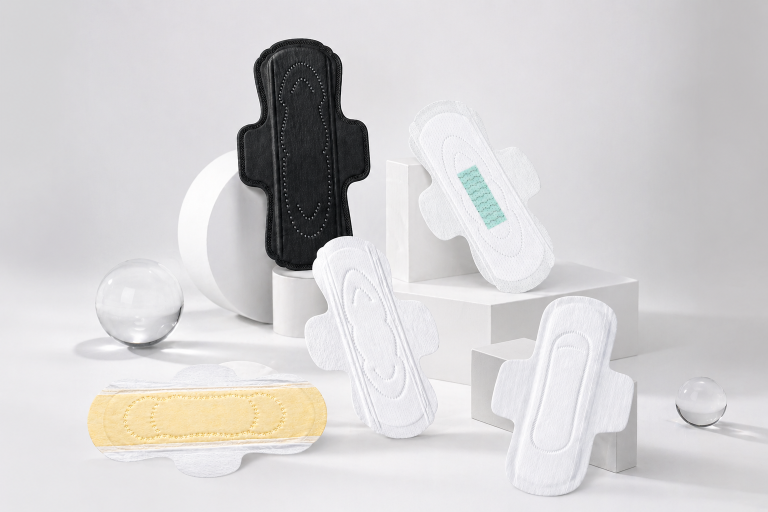
The word "best" in the context of sanitary pads is not a fixed quality — it depends on the user's flow level, skin sensitivity, activity level, and personal preferences. However, there are objective construction and material factors that separate a well-made pad from a poorly made one, regardless of brand positioning or price point.
A genuinely good sanitary pad does all of the following:
- absorbs fluid quickly and prevents it from returning to the surface
- maintains a dry surface feel throughout the wear period
- stays securely in place during movement
- prevents leakage at the sides and back under normal use conditions
- remains comfortable against the skin without causing irritation
- holds its structural integrity without bunching or breaking down during wear
A pad that fails on any of these points is not well-made, regardless of how it is marketed. Understanding what drives each of these performance characteristics helps both consumers and brand owners evaluate products more objectively.
The Construction Factors That Determine Pad Quality
1. Absorbent Core Quality
The absorbent core is the most important quality determinant in a sanitary pad. It consists of fluff pulp combined with superabsorbent polymer (SAP). SAP is the material that locks fluid in and prevents it from being released back to the surface under pressure — a property called dry-back performance. Higher-quality cores use appropriate SAP concentration for the absorbency level, distribute SAP evenly to prevent gel blocking, and maintain structural integrity throughout the wear period.
A core that uses insufficient SAP, distributes it unevenly, or breaks down during wear will leak or leave the surface feeling wet even when the core has remaining capacity. This is the most common quality failure point in lower-cost sanitary pads.
2. Topsheet Performance
The topsheet is the layer in contact with the skin. Its quality affects both fluid transfer speed and surface comfort. A good topsheet transfers fluid quickly into the core — preventing pooling on the surface — while remaining soft enough not to cause friction or irritation during extended wear. A topsheet that transfers fluid slowly creates a wet surface feeling regardless of core quality.
Topsheet material options include standard soft nonwoven, organic cotton, perforated film, and bamboo fiber. Each has different surface characteristics that affect both comfort and product positioning.
3. Leak Barrier Construction
Side leak barriers — the raised edges on the sides of the pad — prevent fluid from reaching the underwear during movement, especially during sleep or physical activity. The effectiveness of leak barriers depends on their height, flexibility, and how well they maintain contact with the body during movement. A pad with weak or improperly positioned leak barriers will leak at the sides even when the core has remaining capacity.
4. Adhesive and Wing Design
The adhesive strip on the back of the pad must hold the pad securely in place during movement without bunching. Wings, when present, fold around the gusset of the underwear to provide additional anchoring. Poor adhesive quality or poorly designed wings are common causes of pad shifting during wear — which leads to leakage from movement rather than from absorbency failure.
5. Backsheet Breathability
The backsheet is the bottom layer of the pad. A breathable backsheet — typically a microporous PE film — allows air circulation while preventing fluid from passing through. Better breathability reduces heat and moisture buildup during extended wear, which improves comfort and reduces skin irritation risk. A non-breathable backsheet increases the likelihood of discomfort during longer wear periods.
6. Raw Material Safety
The materials used in a sanitary pad come into direct contact with sensitive skin for extended periods. Key safety considerations include:
- FBA-free — no fluorescent brightening agents, which are associated with skin sensitivity in some users
- Fragrance-free — no added synthetic fragrances, which are a common source of irritation
- Chlorine-free processing — bleaching without chlorine reduces chemical residue risk
- Third-party testing — SGS or Intertek test reports verify material safety claims independently

How to Match Pad Type to Flow Level
Using the right absorbency level for the current flow is the most important practical decision in pad selection — more important than brand, price, or material. A pad that is too low in absorbency will leak regardless of construction quality; a pad that is appropriate for the flow will perform well if it is well-made.
| Flow Level | Recommended Pad Type | Key Features to Look For |
|---|---|---|
| Very light / spotting | Panty liner | Thin, comfortable for all-day wear, secure adhesive |
| Light to moderate | Regular day pad | Good dry-back performance, soft topsheet, wings optional |
| Heavy flow | Heavy / maxi pad | High SAP core, strong leak barriers, wings standard |
| Overnight / sleep | Overnight pad | Extended length, wider back panel, reinforced side barriers |
| Sensitive skin | Organic cotton pad (any absorbency) | Organic cotton topsheet, fragrance-free, FBA-free, chlorine-free |
What Certifications Indicate Quality in a Sanitary Pad?
Certifications and test reports are more reliable quality indicators than marketing language alone. The following are the most relevant quality and safety certifications for sanitary pads.
| Certification | What It Confirms | Relevance |
|---|---|---|
| ISO 9001 | Quality management system at the manufacturing facility | Baseline manufacturing quality standard — relevant across all markets |
| SGS / Intertek testing | Third-party testing of raw materials and finished product | Verifies specific safety claims — FBA-free, fragrance-free, material safety |
| FDA registration | Manufacturer registered with the US Food and Drug Administration | Relevant for products entering the US market |
| CE marking | Compliance with European product standards | Relevant for European market entry |
| GOTS / OCS | Organic cotton content verification | Required to make verified organic cotton claims on packaging |
For brand owners evaluating manufacturers, always request original certification documents rather than accepting logos on a website. Verify that the issuing company matches the factory you are working with and that the certificates are current. For a full overview of certifications relevant to feminine hygiene OEM, see our guide on what certifications matter for feminine hygiene OEM.
Frequently Asked Questions
What is the most important factor when choosing a sanitary pad?
Absorbency level matched to current flow is the single most important factor. A correctly matched absorbency level prevents leakage regardless of most other product variables. After absorbency, topsheet comfort and leak barrier quality are the next most meaningful performance factors for most users.
Do more expensive pads perform better?
Not necessarily. Price reflects a combination of material cost, brand positioning, packaging, and market. A mid-range pad with good core construction and appropriate absorbency can outperform a premium-priced pad with inferior construction. The most reliable performance indicators are specific construction and material attributes — not price or brand name alone.
What does SAP mean in a sanitary pad?
SAP stands for superabsorbent polymer — the material in the absorbent core that locks fluid in and prevents it from returning to the surface under pressure. SAP concentration is the primary driver of a pad's absorbency capacity and dry-back performance. Higher SAP concentration generally means better fluid retention and a drier surface feel during heavy flow or extended wear.
Are pads with wings better than those without?
Wings improve pad stability during movement by anchoring the pad to the gusset of the underwear. For most users, wings are beneficial — particularly during physical activity or overnight use when movement is greater. Some users prefer wingless designs for everyday light-flow use where stability is less of a concern. Neither is universally better; it depends on use case and personal preference.
For brand owners: how do you verify a manufacturer's quality claims?
Request specific documentation rather than accepting general assurances. Useful verification includes original ISO 9001 certificates, third-party test reports from SGS or Intertek covering specific material safety attributes, and physical samples for hands-on evaluation before any bulk commitment. A manufacturer who cannot provide documentation for their quality claims should be treated with caution. For a full manufacturer evaluation framework, see our guide on how to choose a sanitary pad manufacturer.
For Brand Owners and Importers: What Quality Means in an OEM Context
For private label brands and importers, product quality is not just a consumer experience issue — it is a business risk issue. Inconsistent quality leads to consumer complaints, return requests, and damage to brand trust that is difficult to recover from, particularly for new brands establishing their first market presence.
When evaluating an OEM sanitary pad manufacturer, quality should be assessed across three dimensions:
- Material quality — what raw materials are used, are they consistent batch to batch, and are they verified through third-party testing?
- Process quality — does the manufacturer have documented in-line quality control procedures, and can they explain how they manage batch-to-batch consistency?
- Output quality — does the bulk production match the approved sample, and what is the manufacturer's process for handling quality issues when they arise?
A manufacturer who can answer these questions specifically and provide supporting documentation is demonstrating genuine quality management capability. Vague assurances without documentation are not a reliable quality signal.
For a full framework for evaluating OEM sanitary pad manufacturers — including quality control, certifications, MOQ, and export experience — see our guide on how to choose a sanitary pad manufacturer. For an overview of how to plan and structure a private label pad launch, see our guide on how to start a private label feminine hygiene brand.
Looking for a Quality-Focused Sanitary Pad OEM Manufacturer?
Niceday manufactures sanitary pads with FBA-free materials, third-party tested raw materials, and ISO 9001 certified quality management. We produce across a full range of absorbency levels and material directions — including organic cotton, herbal-inspired, and functional freshness product concepts — for private label brands and distributors in 54+ countries.
Tell us your quality requirements, target market, and product direction — our OEM team will respond with relevant capability information and documentation.
Contact Our OEM Team View OEM Service Details