About This Guide
This guide explains why sensitive skin reacts to conventional sanitary pads, what makes organic cotton pads a better option for many users, and what specific product attributes to look for when choosing a genuinely skin-friendly pad. It is useful for consumers managing period skin irritation, and for brand owners and importers evaluating organic cotton sensitive-skin positioning for private label product development.
Why Sensitive Skin Reacts During Your Period
The skin around the vulva is thinner and more permeable than skin elsewhere on the body. During menstruation, this area is exposed to moisture, warmth, and extended product contact — all of which lower the skin's natural barrier function and increase its vulnerability to irritation.
Common irritant triggers in conventional pads:
| Irritant | Source in Conventional Pads | Effect on Sensitive Skin |
|---|---|---|
| Synthetic nonwoven topsheet | Plastic-based fiber surface layer | Friction and restricted airflow; creates warm, damp conditions that worsen sensitivity |
| Synthetic fragrances | Added to mask odor | Among the most common contact allergens in personal care products; frequently triggers dermatitis |
| Chlorine bleaching | Used to whiten pad materials | Residual chlorine compounds can irritate sensitive tissue |
| Fluorescent brightening agents (FBAs) | Chemical whiteners for bright appearance | Known skin irritant; associated with sensitivity reactions in intimate area contact |
| Chemical adhesives | Adhesive strip on pad back | Can occasionally transfer to skin through thin underwear fabric |
If you experience itching, redness, swelling, or a rash that appears during or shortly after your period and clears up between cycles — pad materials are the most likely cause worth addressing first.
What Makes Organic Pads Better for Sensitive Skin
Organic pads address the most common irritant triggers directly through material and production choices:
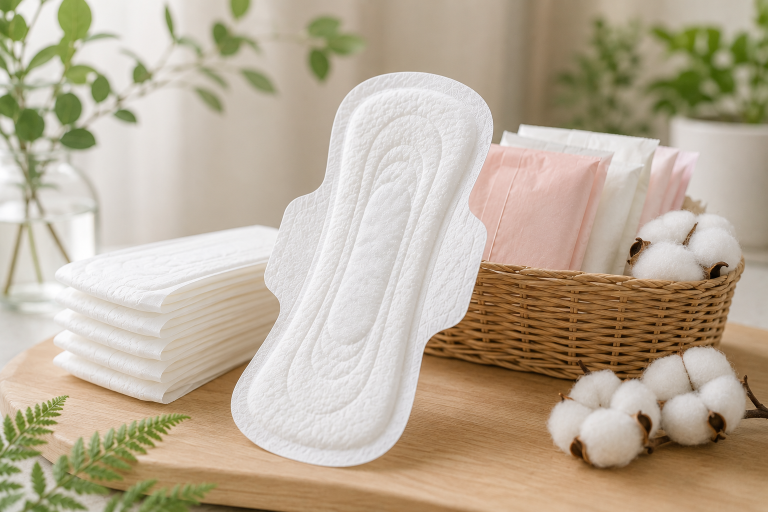
- Organic cotton topsheet — certified organic cotton is grown without synthetic pesticides and processed without harsh chemical treatments. The natural fiber is softer, more breathable, and less likely to cause friction than synthetic nonwoven alternatives. Organic cotton also allows better airflow, which keeps skin drier and reduces the warm, moist conditions that worsen skin sensitivity.
- No synthetic fragrances — genuine organic pads are fragrance-free. Synthetic fragrances are among the most common contact allergens in personal care products and are one of the first things to eliminate for sensitive skin users.
- No chlorine bleaching — organic cotton pads are typically processed without chlorine bleach, removing one of the most common chemical irritants found in conventional pad production.
- FBA-free manufacturing — reputable organic pad manufacturers produce without fluorescent brightening agents. At Niceday, all products across our entire range are FBA-free — not limited to the organic line.
Who Benefits Most from Organic Cotton Pads
Organic cotton pads are particularly well-suited for:
- users with contact dermatitis — skin that reacts to chemical or material contact during pad use
- users with eczema — dry, easily irritated skin that flares with synthetic fiber contact
- users prone to vulvar irritation — recurring discomfort, itching, or redness during menstruation
- users with known fragrance allergies — any fragrance exposure during menstruation can trigger a reaction
- postpartum women — skin is often more sensitive after childbirth; organic cotton is gentler on recovering tissue
- teens using pads for the first time — starting with gentler materials reduces early-cycle skin sensitization
- users in warm climates — higher temperatures increase moisture buildup; organic cotton's breathability provides meaningful comfort improvement
Organic Pads vs Conventional Pads: Sensitive Skin Comparison
| Factor | Organic Cotton Pads | Conventional Synthetic Pads |
|---|---|---|
| Topsheet material | Certified organic cotton — natural, soft fiber | Synthetic nonwoven — plastic-based fiber |
| Fragrance | None — fragrance-free production | Often added — common contact allergen |
| Bleaching process | Chlorine-free | May use chlorine bleaching |
| FBAs | None | May be present |
| Breathability | Higher — natural cotton fiber allows airflow | Lower — synthetic surface restricts airflow |
| Skin friction | Lower — softer fiber reduces friction | Higher — synthetic fibers may cause friction |
| Absorbency | Equal — determined by core, not topsheet | Equal — determined by core structure |
| Price range | Mid to premium segment | Mass market to mid segment |
How to Read Organic Pad Labels: What to Look For
Not all pads labeled "natural," "gentle," or "sensitive" contain organic cotton or verified clean-ingredient construction. The following table explains what each label claim actually means and how reliable it is as a quality indicator.
| Label | What It Means for Sensitive Skin | Reliability |
|---|---|---|
| GOTS certified | Organic cotton verified through the full production chain — most comprehensive standard | Most reliable |
| OCS certified | Organic cotton content verified; does not cover the full production process | Reliable for cotton content claims |
| Fragrance-free | No added scents — essential for contact allergen avoidance | Reliable — request confirmation or test report |
| FBA-free | No fluorescent brightening agents — important skin safety indicator | Reliable — verify with third-party test report |
| Chlorine-free | No chlorine bleaching — reduces chemical residue exposure | Reliable — confirm with manufacturer documentation |
| "Natural" or "gentle" (no certification) | Marketing language only — no verified organic content or clean-ingredient standard | Not verified — treat with caution |
| "Dermatologist tested" | Testing scope varies widely — does not guarantee absence of specific irritants | Depends on test scope — request the full report |
The most reliable sensitive-skin pads show multiple positive indicators — not just one. A pad that is fragrance-free but still uses a synthetic topsheet is better than a scented pad, but not as gentle as one combining organic cotton, fragrance-free production, FBA-free materials, and chlorine-free processing together.
How to Transition to Organic Pads
- Start on a lighter flow day — assess comfort when you have more time to evaluate rather than managing heavy flow.
- Give it at least one full cycle — skin that has been regularly irritated may take one to two cycles to settle after removing the irritant. If irritation reduces but does not fully disappear in the first cycle, continue through a second before evaluating.
- Change regularly — even with organic cotton, change every 4–6 hours. Damp conditions are a primary cause of skin irritation regardless of pad material.
- Check the full ingredient list — if irritation continues after switching to an "organic" pad, check whether it contains added fragrance, aloe vera gel, or botanical additions. Some users react to these even in natural form.
Why Organic Cotton Pad Demand Is Growing: A Note for Brand Owners
Sensitive skin is one of the fastest-growing drivers of product switching in the feminine hygiene category globally. Consumer demand for hypoallergenic and skin-friendly pads is moving from niche positioning to mainstream shelf space in markets including Europe, the Middle East, Russia, and parts of Asia.
For distributors and private label brand owners, this represents a clear commercial opportunity. Organic cotton pads positioned around sensitive-skin comfort consistently perform well in repeat purchase and consumer word-of-mouth — two metrics that matter significantly for brand building in the feminine hygiene category.
Key considerations for brand owners evaluating this direction:
- sensitive-skin organic pads can carry a higher retail price point than standard pads in most markets
- the positioning requires genuine material and certification support — not just packaging language
- a daily liner and a regular day pad are the most practical starting SKUs for this product direction
- certification documentation — GOTS, OCS, FBA-free test reports — must be in place before packaging claims are finalized
For a full overview of organic cotton pad OEM options and sourcing considerations, see our guide on organic cotton sanitary pads: OEM sourcing guide for brand owners. For sensitive-skin product development more broadly, see our guide on sensitive-skin feminine hygiene products for buyers.
Frequently Asked Questions
Can organic pads completely eliminate period skin irritation?
For many users, switching to organic cotton pads significantly reduces or eliminates irritation caused by synthetic materials and fragrances. However, if irritation persists after switching, it may be caused by moisture, pad change frequency, or other factors unrelated to pad material. Persistent or severe irritation should be evaluated by a dermatologist or gynecologist rather than managed through product switching alone.
Are all organic pads hypoallergenic?
Not all products labeled "organic" are hypoallergenic. A genuinely low-irritation organic pad should combine organic cotton topsheet, fragrance-free production, FBA-free materials, and chlorine-free processing. Products that are organic cotton only but still contain added fragrances or botanical additives may still trigger reactions in sensitive users. Check the full ingredient and production attributes rather than relying on a single claim.
Do organic pads absorb as well as regular pads?
Yes — absorbency is determined by the core construction, not the topsheet material. A well-constructed organic cotton pad with an appropriate core weight and SAP concentration performs at the same absorbency level as a conventional pad of equivalent specification. Organic cotton topsheets do not reduce absorbency capacity.
How do I know if my irritation is caused by my pad?
The clearest indicator is pattern: irritation that appears during or shortly after your period and clears up between cycles is likely pad-related. If the irritation is present continuously throughout the month, pad material is less likely to be the primary cause. Switching to an organic, fragrance-free, FBA-free pad for one full cycle is the most practical first test — if irritation reduces or resolves, pad materials were a significant contributing factor.
Are there organic cotton options for heavy flow?
Yes — organic cotton topsheets are available across all absorbency levels, including heavy flow and overnight pads. The organic cotton is used in the topsheet layer; the core construction beneath it can be specified for any absorbency level. Users with sensitive skin and heavy flow do not need to compromise on protection to use gentler materials.
For brand owners: can organic sensitive-skin pads be sourced through OEM programs?
Yes — organic cotton sensitive-skin pads are well-suited to OEM development. The key requirements are confirming the manufacturer holds current GOTS or OCS certification, can provide FBA-free and fragrance-free construction with supporting test reports, and can support packaging development with appropriate certification claims. Not all manufacturers meet all of these requirements — confirm explicitly before committing to a development project.
Looking for Organic Cotton Pad OEM for Sensitive-Skin Positioning?
Niceday manufactures organic cotton sanitary pads — FBA-free and fragrance-free across all formats — with GOTS and OCS certification support for private label brands requiring verified organic claims. We supply brand owners and distributors in 54+ countries from our facility in Foshan, China, with 14 intelligent production lines and daily capacity of 9.8 million pieces.
Tell us your target market, certification requirements, and product direction — our OEM team will respond with relevant options and documentation.
Contact Our OEM Team View OEM Service Details