About This Guide
This guide explains how sanitary pad absorbency works, what product construction factors affect performance, and how absorbency levels are structured across different product types. It is useful for consumers choosing the right pad for their flow, and for brand owners and importers evaluating absorbency positioning when planning a private label product line.
What Absorbency Actually Means in a Sanitary Pad
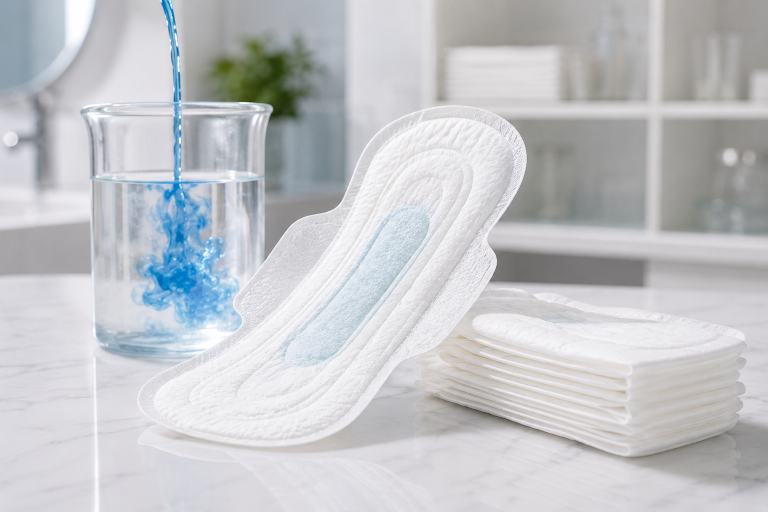
Absorbency refers to how much fluid a sanitary pad can hold, how quickly it draws fluid away from the surface, and how well it retains that fluid under pressure — such as during movement or sleep. A pad that absorbs slowly, leaks under pressure, or leaves the surface feeling damp is performing poorly regardless of how it is labeled.
For consumers, absorbency determines how long a pad can be worn comfortably and how much protection it provides during heavier flow periods. For brand owners evaluating OEM product options, absorbency specification is one of the most important decisions in product development — it directly affects product positioning, material cost, and consumer experience.
The Four Construction Factors That Determine Absorbency
Absorbency in a sanitary pad is not determined by a single material or feature. It is the result of how several layers work together. Understanding these layers helps consumers make better product choices — and helps brand owners understand what they are specifying when they discuss product construction with a manufacturer.
1. Absorbent Core
The absorbent core is the central layer that holds the majority of fluid. Most modern sanitary pads use a combination of fluff pulp and superabsorbent polymer (SAP) in the core. SAP is the material that locks fluid in and prevents it from being released back to the surface under pressure. Higher SAP concentration generally means higher absorbency capacity and better dry-back performance.
Core weight and SAP concentration are the primary variables a manufacturer adjusts when producing pads at different absorbency levels — from light panty liners to heavy overnight pads.
2. Topsheet Material
The topsheet is the layer in direct contact with the skin. Its role in absorbency is to transfer fluid quickly into the core rather than allowing it to pool on the surface. A topsheet that transfers fluid slowly creates a wet surface feeling even if the core has capacity remaining.
Common topsheet materials include:
- Soft nonwoven — the standard option; good fluid transfer, comfortable for most users
- Organic cotton — increasingly popular for comfort-focused and natural product positioning; transfers fluid well while offering a softer surface feel
- Perforated film — used in some ultra-thin designs; fast fluid transfer but less soft against skin
3. Core Distribution Layer
Between the topsheet and the absorbent core, many higher-performance pads include a distribution layer — sometimes called an acquisition and distribution layer (ADL). This layer spreads fluid across a wider area of the core before it is absorbed, which prevents the core from becoming saturated in one spot while the surrounding area remains unused. Better distribution means more efficient use of core capacity and more consistent performance over time.
4. Backsheet and Leak Barriers
The backsheet is the bottom layer of the pad — the side that contacts the underwear. Its role in absorbency protection is to prevent fluid from passing through the core and reaching the underwear. Most modern pads use a breathable PE film backsheet that blocks fluid while allowing some air circulation.
Side leak barriers — the raised edges on some pad designs — provide additional protection against leakage at the sides during movement or heavy flow. These are particularly important for overnight and heavy-flow pad designs.
Absorbency Levels: How Pads Are Classified
Sanitary pads are typically produced and sold across several absorbency levels. The naming conventions vary by brand and market, but the underlying structure is consistent.
| Absorbency Level | Typical Use | Key Construction Features |
|---|---|---|
| Light / Panty liner | Light discharge, light flow days, backup protection | Thin core, minimal SAP, no wings typically |
| Regular / Day | Normal flow during daytime hours | Standard core weight, wings optional, moderate SAP |
| Heavy / Maxi | Heavier flow days, longer wear intervals | Higher core weight, increased SAP, wings standard |
| Overnight / Ultra | Sleep protection, maximum flow coverage | Extended length, reinforced leak barriers, high SAP concentration, wider back panel |
For most users, having two or three absorbency levels covers the full range of a typical menstrual cycle — a regular pad for lighter days, a heavy pad for peak flow days, and an overnight pad for sleep. Using a higher absorbency pad than needed is generally not harmful, but a lower absorbency pad than flow requires leads to leakage and more frequent changes.
Organic Cotton and High Absorbency: Do They Work Together?
A common question from consumers — and from brand owners evaluating product positioning — is whether organic cotton pads can deliver the same absorbency as standard pads.
The answer is yes, with the right construction. Organic cotton is used primarily in the topsheet layer — the surface that contacts the skin. Its role is fluid transfer and surface comfort, not fluid storage. The absorbent core beneath the topsheet determines the pad's overall absorbency capacity, and this core construction is independent of whether the topsheet is organic cotton or standard nonwoven.
A well-constructed organic cotton pad with an appropriate core weight and SAP concentration can perform at the same absorbency level as a standard pad of equivalent specification. The organic cotton topsheet adds skin-comfort and natural-material positioning without reducing absorbency performance when the product is correctly designed.
For brand owners, this means organic cotton and high absorbency are not a trade-off — they can be combined in a single product. For more detail on organic cotton OEM product options, see our guide on organic cotton sanitary pads: OEM sourcing guide for brand owners.
For Brand Owners and Importers: Absorbency as a Product Line Decision
For private label brands and importers, absorbency structure is one of the first product line decisions to make before approaching a manufacturer. The absorbency range you choose determines your SKU count, your target consumer segments, and your positioning relative to existing products in your market.
Key decisions at this stage:
- Which absorbency levels will you carry? A day pad and a night pad cover the core use cases for most markets. Adding a heavy variant or an ultra-thin variant expands coverage but increases SKU count and total MOQ commitment.
- Will you differentiate by material? Organic cotton topsheet, herbal-inspired product direction, or functional freshness positioning can all be applied at any absorbency level and help differentiate your brand from standard market options.
- What does your target market expect? Overnight pad length, wing configuration preferences, and absorbency labeling conventions vary by market. A manufacturer with export experience in your target region can advise on local product expectations.
For an overview of how OEM sanitary pad projects are structured — including MOQ per absorbency level and typical lead time — see our guide on OEM sanitary pads: MOQ, packaging, and lead time explained.
Frequently Asked Questions
What makes an overnight pad more absorbent than a regular pad?
Overnight pads are more absorbent primarily because they use a heavier core with higher SAP concentration, an extended length to provide front-to-back coverage during lying down, and reinforced side leak barriers. The wider back panel on most overnight designs also provides additional protection during side-sleeping positions.
Does a thicker pad always mean more absorbency?
Not necessarily. Ultra-thin pads can achieve high absorbency through efficient SAP use and a well-designed distribution layer, while a thicker pad with lower SAP concentration may perform less well under heavy flow conditions. Thickness is a product design choice — it affects how the pad feels to wear, not directly how much it can absorb. Many consumers prefer ultra-thin designs for daytime wear even at higher absorbency levels.
How do I know if a pad is genuinely high-absorbency or just marketed that way?
Look for specific construction information rather than general claims. Useful indicators include the absorbency level classification (regular, heavy, overnight), the presence of a distribution layer, the core material description, and whether the product includes leak barriers. Third-party testing references — such as SGS or Intertek testing — are a stronger trust signal than unverified marketing language.
Are organic cotton pads less absorbent than regular pads?
No — when correctly constructed, organic cotton pads can achieve the same absorbency as standard pads. The organic cotton is used in the topsheet layer for surface comfort and material positioning. The core construction beneath it determines absorbency capacity and is independent of the topsheet material choice.
For brand owners: can absorbency be customized in an OEM project?
Yes. In an OEM sanitary pad project, absorbency level is one of the primary customizable specifications. Core weight, SAP concentration, pad length, and leak barrier design can all be adjusted to achieve a target absorbency performance. Brand owners specify their absorbency requirements during the product development stage, and manufacturers produce samples to those specifications for approval before bulk production.
Looking for High-Absorbency OEM Sanitary Pads?
Niceday manufactures sanitary pads across a full range of absorbency levels — from daily liners to heavy overnight designs — with customizable core specifications, topsheet material options including organic cotton, and private label packaging support. Our facility in Foshan, China operates 14 intelligent production lines with daily capacity of 9.8 million pieces, supplying brand owners and distributors in 54+ countries.
Tell us your target absorbency range, market, and product direction — our OEM team will respond with relevant product options and next steps.
Contact Our OEM Team View OEM Service Details