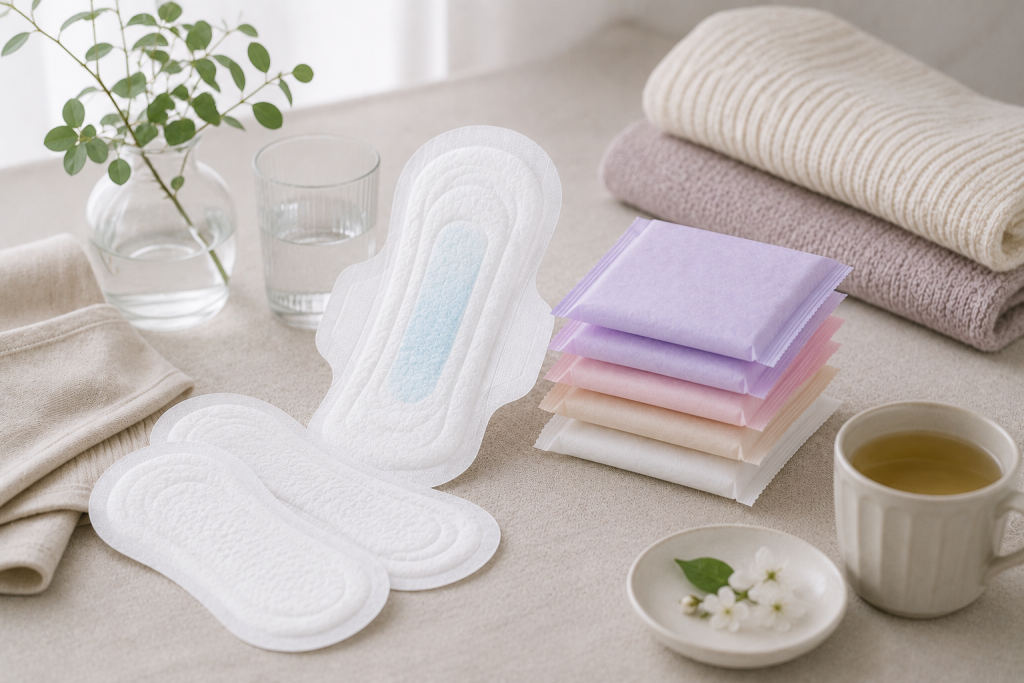
Maternity Pads: Why Bigger Is Not Better, and What to Specify Instead
Maternity pads are usually developed by taking a regular pad and making it longer and thicker. Buyer feedback splits sharply on the result: some value the coverage, others describe the product as too bulky and switch to ordinary pads as soon as the heaviest stage passes. The specification target is not more volume but high coverage at low perceived bulk — which means specifying post-absorption thickness, sitting compression behaviour, core stability under high load, and wing anchoring.
Where this signal comes from: user discussions in pregnancy and postpartum communities show two opposite verdicts on the same product category in the same threads — one group valuing full coverage and stability, another describing maternity pads as too bulky and moving to standard products earlier than the recovery stage would suggest.
Why the two verdicts are both correct
The buyers valuing coverage and the buyers rejecting bulk are describing different attributes that are usually bundled together in development. Length and thickness are increased at the same time, so a buyer cannot get one without the other.
They can be separated. Coverage is a function of length, width and where the absorbent zone sits. Perceived bulk is a function of thickness profile, core density and how the product behaves under compression. A product can have high coverage and low perceived bulk — it simply requires specifying them as two independent targets rather than one.
Post-absorption thickness: the value that matters most
Most thickness specifications describe the dry product. Buyers experience the loaded product. A pad that measures acceptably dry can become substantially thicker in use, and that is the point at which bulk complaints appear.
What to specify:
- Thickness dry and thickness at defined load levels, not one figure
- Thickness profile across the product, not a single centre measurement — bulk is often felt at the ends and edges rather than the centre
- Swelling direction — whether the core expands in thickness or distributes across area, since the second is considerably less noticeable
Core composition and density are the levers here. A denser core that distributes rather than swells upward delivers the same capacity at lower perceived bulk.
Sitting compression behaviour
Postpartum buyers sit for long periods, often while feeding, and sitting is where bulk and discomfort are most reported. Two behaviours to specify:
- Compression recovery — whether the product returns to shape or holds a compressed profile after prolonged sitting
- Ridge formation — whether the core folds or forms a raised line under pressure, which is felt distinctly and also changes coverage
Test seated for a realistic duration and at more than one load level. A product that recovers well when dry may not when loaded.
Core stability under high volume
At the volumes a maternity pad is designed for, core behaviour changes. Three failure modes worth testing separately:
| Behaviour | What the user experiences | Specification lever |
|---|---|---|
| Core displacement | The absorbent mass moves, leaving a thin area | Core wrap integrity, embossing, core bonding |
| Core breakup | The core separates into sections; lumps are felt | Core cohesion at high load, wrap strength |
| Uneven distribution | One area saturated while another stays dry | Acquisition layer, distribution channel design |
These are the mechanisms behind complaints that read as unreliability rather than as capacity shortfalls, and none of them show up in a total-capacity figure.
Wing anchoring and product movement
Movement is the single most consistent complaint about pads in this category — the product shifting, being positioned imprecisely, or staining underwear. Wing anchoring is the main control:
- Wing position and length relative to the total product length
- Adhesive placement and strength on both body-facing panel and wings
- Adhesive behaviour on different fabrics, since postpartum buyers frequently use fuller-coverage underwear
- Repositioning tolerance — whether the product survives one adjustment without the adhesive failing
This is also the point of genuine differentiation against pull-on products. A pull-on product's advantage is that the absorbent layer is fixed in the garment and cannot move. A maternity pad competing with it needs anchoring specified rather than assumed.
Surface softness at high load
Surface feel is normally assessed dry, but the relevant state for this product is heavily loaded over an extended period. Specify:
- dry surface softness and softness at defined load levels, as separate values
- rewet performance, since surface wetness drives the wet-feeling complaint
- friction in the loaded state, not only dry
Wording for a low-bulk maternity pad
| Use, if accurate | Avoid |
|---|---|
| Full coverage, low profile | Maximum absorbency |
| Extended front-to-back protection | Feels like nothing |
| Stays in place with secure wings | No shifting or will not move |
| Soft surface, designed for long wear | Safe for stitches, or any reference to surgical sites |
| Change according to flow and comfort | Fixed change intervals as a rule |
Anything relating to recovery, healing or tissue belongs with a healthcare professional. Where a postpartum product discusses heavier flow, include a short line directing buyers to professional advice.
What this means for private label buyers
Specify coverage and bulk as two independent targets. Require thickness at load rather than dry only, add seated compression and core stability at high volume to the test plan, and specify wing anchoring rather than inheriting it from a regular pad.
Niceday manufactures maternity pads, disposable postpartum underwear, sanitary pads, panty liners and disposable menstrual pants from a 50,000 square meter facility in Foshan, China, with 14 intelligent production lines and a daily capacity of 9.8 million pieces, exporting to 54+ countries. Standard MOQ is 300,000 pieces per SKU with a 35–40 day lead time.
Develop a low-bulk maternity pad
Send your coverage requirements and target market, and our team will propose core composition and thickness targets with a load-state test plan.
Email: winnie@everyniceday.com
Request a Specification ProposalFrequently Asked Questions
Why do buyers describe maternity pads as too bulky?
Because coverage and thickness are usually increased together in development, so a buyer wanting more coverage cannot avoid more bulk. The two can be specified as independent targets.
Why specify thickness at load rather than dry?
Because buyers experience the loaded product. A pad that measures acceptably dry can become substantially thicker in use, and that is where bulk complaints appear.
What is the difference between core swelling and core distribution?
Swelling increases thickness upward; distribution spreads absorbed volume across area. Distribution is considerably less noticeable to the user, so core density and composition can deliver the same capacity at lower perceived bulk.
Which core behaviours should be tested at high volume?
Core displacement, core breakup into sections, and uneven distribution. Each has a different specification lever and none is visible in a total-capacity figure.
Why does wing anchoring need explicit specification?
Because product movement is the most consistent complaint in this category, and it is the specific advantage pull-on products have. Wing position, adhesive placement and strength, behaviour on different fabrics, and repositioning tolerance all need defining.
What should be tested for surface comfort?
Dry softness and softness at defined load levels as separate values, plus rewet performance and friction in the loaded state, since the relevant condition is heavy load over an extended period.