Market Guide for Gulf & Middle East Buyers
Sourcing Feminine Hygiene Products for the Middle East
Middle East feminine hygiene markets reward product quality and presentation more than price alone. Across Saudi Arabia, the UAE, Qatar, Kuwait, Oman, Jordan, and Iraq, distributors and brand owners compete in modern retail and pharmacy channels where packaging, product feel, and shelf presence carry real weight.
This guide covers product positioning for Gulf and wider Middle East markets, Arabic packaging requirements, certification and documentation expectations, and what to confirm with a manufacturer before ordering.
In short: what Middle East buyers should plan for
Product positioning in the Gulf leans premium: soft surface materials, clean packaging design, and differentiated concepts such as herbal-inspired or freshness-oriented lines perform well alongside standard daily protection. On the practical side, plan for Arabic-language packaging, product registration and conformity requirements that differ by country, and halal certification where the destination market or retail channel requires it.
A manufacturer supports this with specification development, Arabic artwork implementation, and documentation. Product registration and import approval normally sit with the local importer. Requirements differ by country and change over time — confirm current rules with your national standards or health authority before shipment.
What Shapes Demand in Middle East Markets
Middle East feminine hygiene demand is shaped by a different mix of factors than most other export regions. These directly affect which product specifications and pack formats sell through.
Premium-tolerant consumers
GCC consumers are generally willing to pay for better surface materials, softer feel, and stronger packaging presentation. Ultra-cheap positioning is usually not the winning strategy in modern retail.
Hot climate usage
High temperatures increase the importance of breathability, freshness positioning, and skin comfort. Breathable backsheet and soft topsheet options are frequently requested specifications.
Strong pharmacy channel
Pharmacy chains are a major route to market across the Gulf. This channel expects clear certification documentation and a more clinical, trust-led pack presentation.
Distributor-led structure
Most brands enter through an appointed local distributor with existing retail relationships. Exclusive territory arrangements are common and shape how private label programmes are planned.
Functional concepts perform
Herbal-inspired and freshness-oriented product lines have shown stronger acceptance in Middle East and Southeast Asian markets than in most Western retail channels.
Large re-export hubs
The UAE in particular serves as a re-export base into wider regional markets, which affects volume planning, carton specification, and multi-market artwork decisions.
Practical implication: for most Middle East programmes, the strongest opening range is a premium-positioned core line — soft or organic cotton topsheet, breathable construction, clean Arabic-English packaging — supported by one differentiated concept SKU such as a herbal-inspired or freshness-oriented product.
Product Directions That Fit the Region
Product specification, not just category selection, determines how well a range performs in Gulf retail and pharmacy channels.
Core Volume
Sanitary Pads — Premium Daily & Night
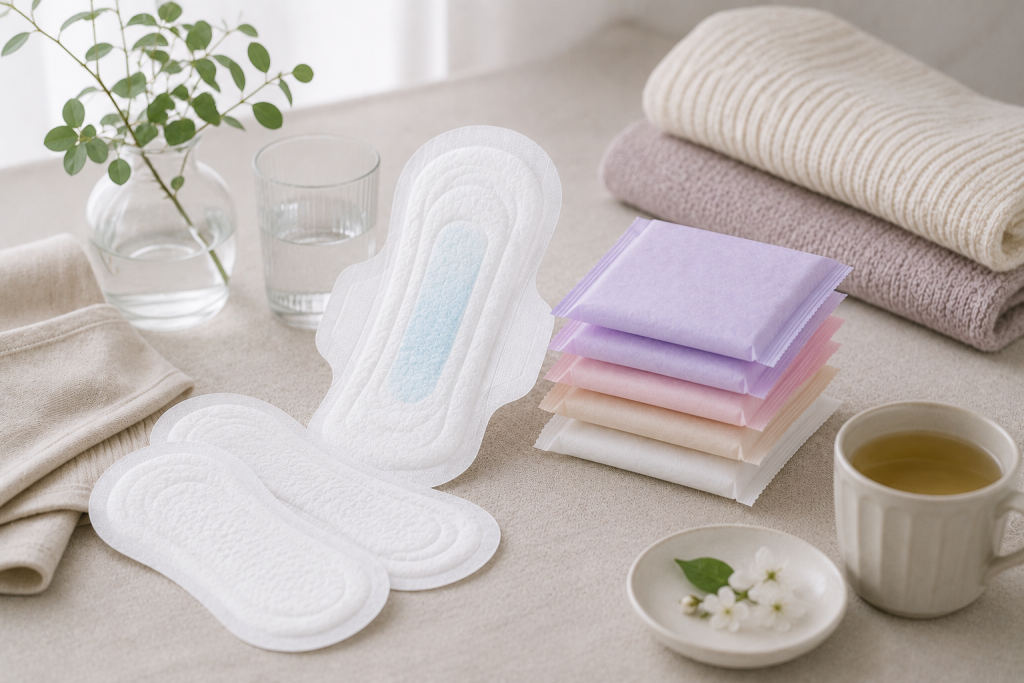
The volume backbone of any Middle East range. Buyers typically request a soft cotton-feel or organic cotton topsheet, breathable backsheet, and a full size ladder from day-use through extended night formats.
Commonly specified:
- 245 mm day-use as core SKU
- 285–330 mm for heavier flow
- 330–420 mm extended night formats
- Organic cotton or cotton-feel topsheet
- Breathable backsheet for hot climates
Differentiation
Herbal & Freshness Concept Lines
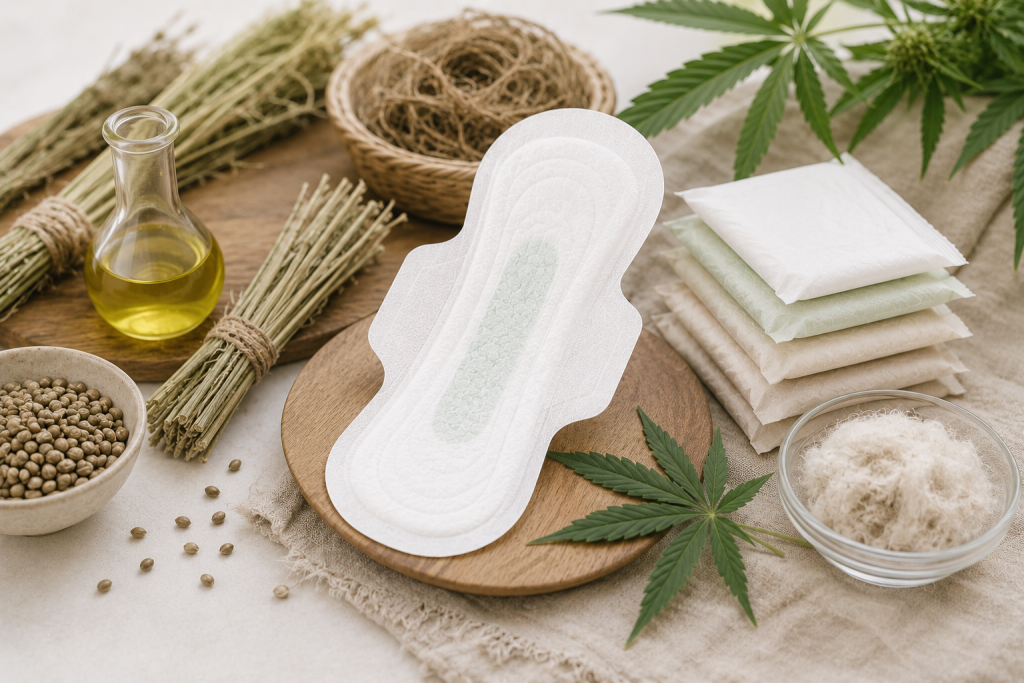
Herbal-inspired and freshness-oriented concepts have consistently stronger acceptance in Middle East markets than in Western retail. They give a distributor a differentiated SKU that is harder for competitors to match on price alone.
Positioning note:
These lines should be presented as comfort and freshness concepts. Health, treatment, or therapeutic claims are not appropriate and can create both regulatory and retail-listing problems.
Complementary
Panty Liners
Daily-use liners suit the region's comfort and freshness priorities and drive repeat purchase beyond menstruation days. Strong margin-to-volume ratio and a natural companion SKU alongside pads.
Available directions:
- Standard and long formats
- Breathable construction
- Individually wrapped for handbag use
Emerging
Menstrual Pants & Maternity Range
Disposable menstrual pants and postpartum products are gaining ground in premium urban retail and maternity channels. Useful as a range extension once the core pad line is established.
Available directions:
- Sizes M to XXL
- Overnight and postpartum formats
- Retail-ready or hospital-kit packaging
Packaging, Certification, and Market Entry Considerations
Requirements vary significantly between Gulf states and wider Middle East markets. The table below shows the areas most often raised in sourcing discussions and where responsibility usually sits.
| Area | What buyers should plan for | Usually handled by |
|---|---|---|
| Arabic labelling | Arabic-language product information is normally expected, commonly as bilingual Arabic-English artwork covering product description, size, count, and usage information. | Manufacturer implements; importer approves wording |
| Conformity & registration | Gulf states operate their own standards and conformity frameworks, and product or establishment registration may be required before import. Rules differ by country. | Local importer registers; manufacturer supplies documents |
| Halal certification | Some markets and retail channels request halal certification for personal care products. Confirm early whether your destination market or retailer requires it, as it affects material sourcing and timeline. | Discuss with manufacturer at specification stage |
| Material safety evidence | Third-party test reports and quality certification support both customs clearance and pharmacy-channel listing decisions. | Manufacturer provides test reports and certificates |
| Shipping & carton spec | High summer temperatures affect storage and transit. Carton strength, palletisation, and pack integrity should be confirmed for the shipping route and season. | Agreed jointly at order confirmation |
Certification and registration requirements differ by country and are updated periodically. Confirm current requirements with your national standards or health authority, or with a local regulatory consultant, before finalising artwork and shipment plans.
What to Confirm With a Manufacturer
Arabic artwork capability
Confirm the factory can produce right-to-left Arabic layout correctly, not simply place translated text into a Latin-script design. Request a full artwork proof before mass production.
Regional export experience
A manufacturer with Middle East shipping history understands documentation expectations, carton specification for hot-climate transit, and typical distributor order patterns.
Certification and test documentation
ISO 9001 and ISO 14001 as the quality baseline, plus third-party test reports matching your actual specification — not generic reports for unrelated products.
Premium specification options
Confirm the factory actually runs organic cotton topsheet, breathable backsheet, and differentiated concept lines — not just standard economy specifications with premium packaging.
Samples from your agreed specification
Evaluate physical samples produced to your specification before bulk commitment. Surface feel and absorbency performance cannot be judged from a specification sheet, and pharmacy buyers will assess both.
How Niceday Supports Middle East Buyers
Niceday is a feminine hygiene manufacturer based in Foshan, China, exporting to 54+ countries including Middle East markets. We work with regional distributors, importers, and private label brand owners on specification development, Arabic packaging, and bulk supply.
Manufacturing scale
A 50,000 m² facility with 14 intelligent production lines and daily capacity of 9.8 million pieces, supporting distributor volume and repeat order cycles.
Bilingual packaging support
Arabic-English artwork development, pack count adjustment, and format selection for modern retail, pharmacy, or wholesale channels.
Premium specification range
Organic cotton topsheet, breathable construction, and herbal or freshness concept lines available as specification options. All products are free of fluorescent brightening agents.
Reference: OEM cooperation terms
Standard MOQ
From 300,000 pcs / SKU
Lead time
35–40 days from confirmation
Certifications
ISO 9001 · ISO 14001 · CE · FDA · SGS
Export markets
54+ countries worldwide
Bilingual artwork on one SKU can serve several regional markets within a single production run. Full details on our OEM/ODM service page.
Frequently Asked Questions
Can packaging be produced in Arabic? +
Yes. Bilingual Arabic-English artwork is a standard requirement for Middle East programmes and is developed at the artwork stage, including right-to-left layout, product description, size and count information, and usage details. A full artwork proof is provided for approval before mass production.
Is halal certification required for feminine hygiene products? +
It depends on the destination market and the retail channel. Some markets and retailers request halal certification for personal care products, while others do not. Because certification affects material sourcing and adds time to the project, raise this at the specification stage rather than after artwork is confirmed. Confirm the requirement with your local authority or retail partner.
Which product concepts work best in Gulf markets? +
A premium-positioned core pad line — soft or organic cotton topsheet, breathable construction, full day-to-night size range — supported by one differentiated concept SKU such as a herbal-inspired or freshness-oriented product. Functional concepts have shown stronger acceptance in Middle East markets than in most Western retail channels.
What is the MOQ and lead time? +
The typical MOQ is 300,000 pieces per SKU, with a production lead time of 35–40 days after order and artwork confirmation. Sampling and artwork development happen before this period. Distributors entering several regional markets can often use one bilingual artwork across markets to work efficiently within the MOQ.
Who handles product registration in the destination country? +
Product registration and import approval normally sit with the local importer or distributor, since these processes require an entity established in the destination country. The manufacturer's role is to supply the supporting documentation — certificates, test reports, material declarations, and product specifications — that the registration process requires.
Related Resources
Planning a Middle East Sourcing Programme?
Tell us your target countries, distribution channel, product specification, and volume range. Our team will respond with a product proposal, Arabic packaging plan, and documentation package.
Request samples and documentation — Physical samples and certification documents can be provided for evaluation before any order commitment.