What this page is: A summary of product preferences reported by women from different countries at an International Women's Day 2025 event attended by Niceday.
Who it is for: Brand owners, importers and private label buyers deciding which specifications to launch in which market.
Main finding: Preferences split along two lines — material and environmental profile in some markets, portability and packaging format in others.
In March 2025 Niceday took part in an International Women's Day event bringing together women from a range of countries and backgrounds. Alongside the programme, our team ran product trials and open conversations about how women choose period products. The value of that exercise, for anyone planning a product range, is in the differences between groups rather than the averages.
Two clear preference patterns
Across the conversations, two distinct priorities came up repeatedly, and they rarely appeared in the same group of users.
| Priority | What users asked about | OEM implication |
|---|---|---|
| Environmental profile | Material sourcing, biodegradability, how much plastic is in the pad and the wrapper | Biodegradable or plant-based construction, unbleached options, packaging material choice |
| Portability | Whether a pad fits discreetly in a small bag or pocket, how easy the wrapper is to open | Folded formats, compact individual wrapping, smaller carry packs as a separate SKU |
This matters for range planning. A single flagship specification rarely satisfies both groups, and trying to build one product that does usually raises unit cost without winning either segment. It is normally more effective to run two positioned SKUs. Reference specifications are available in the biodegradable series and the full product catalogue.

Feedback on the herbal cotton samples
The products offered for trial came from our herbal cotton line, which combines a botanical ingredient direction with a cotton top sheet. Feedback focused on surface feel and on packaging clarity — specifically, whether the ingredient information on the pack was easy to understand.
That last point is a practical warning for brand owners. Herbal and botanical positioning sells on clarity, not on strength of claim. Niceday keeps this line within comfort and product-concept language and does not describe it in medical or therapeutic terms, and we advise brand partners to do the same — several markets, including the EU, treat stronger wording as a regulatory question rather than a marketing one. See the HerbalCool mint and aloe pad for how the line is specified.
Packaging and stigma: a real commercial factor
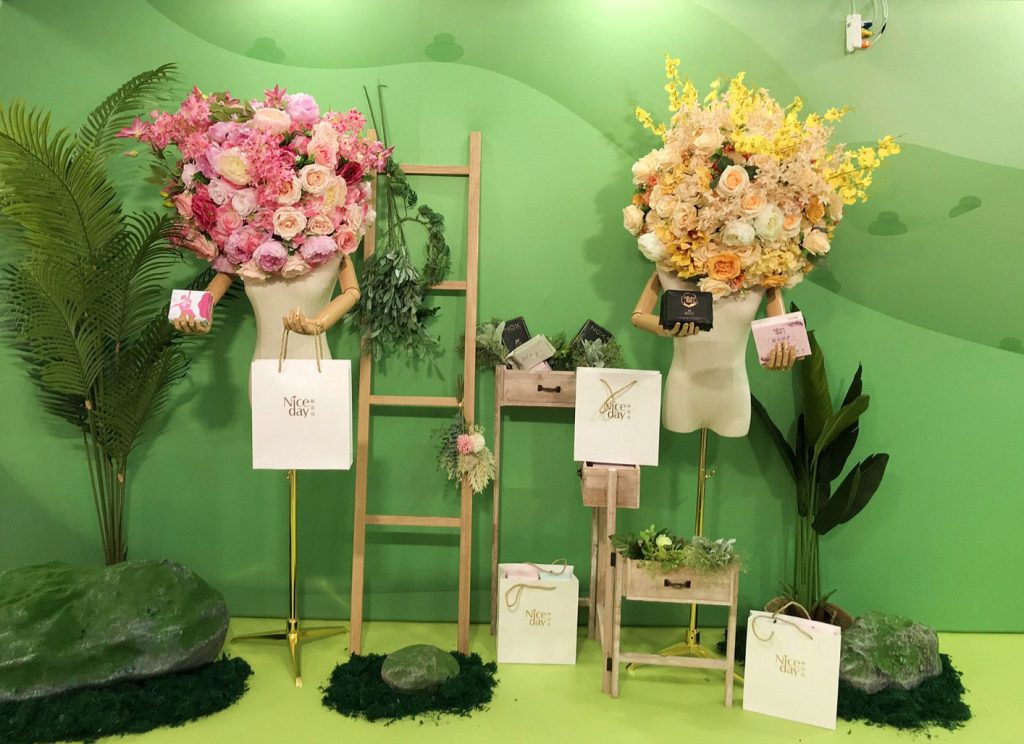
The event also included a session where participants used sanitary pads as material for floral arrangements — an exercise aimed at reducing the discretion habits that still surround the category.
Behind that is a design question buyers actually face. In some markets, discreet packaging is the requirement: quiet wrappers, neutral colours, small formats. In others, open and visible design now performs better. This is one of the first decisions to settle in a packaging brief, because it drives artwork, wrapper material and pack size together. See custom packaging support for the available formats.

How Niceday uses this input
Feedback of this kind feeds directly into how we develop and specify products for OEM and ODM partners. Niceday operates a 50,000 sqm facility in Foshan, China with 14 intelligent production lines and a daily capacity of 9.8 million pieces, and exports to 54+ countries. Products are manufactured under ISO 9001 and ISO 14001, with CE, FDA registration and SGS testing, and without fluorescent brightening agents. MOQ is 300,000 pieces per SKU, with a lead time of 35–40 days after specification and artwork confirmation.
Frequently asked questions
Do period care preferences really differ that much between markets?
Yes. Environmental profile and material sourcing lead in some markets, while portability and packaging format lead in others. These preferences point to different specifications, so they are usually best served by separate SKUs rather than one combined product.
Can Niceday produce biodegradable sanitary pads for private label?
Yes. Biodegradable and plant-based constructions are available for OEM and private label projects, including unbleached options and packaging material choices. Specification and available claims should be confirmed per target market.
How should herbal pads be described on packaging?
Niceday keeps herbal positioning within comfort and product-concept language and avoids medical or therapeutic wording. Stronger claims can create a regulatory issue in markets such as the EU, so the claim set should be confirmed before artwork is finalised.
Is discreet or visible packaging better?
It depends on the market. Discreet wrappers and neutral colours remain the expectation in some regions, while open and visible design performs better in others. This should be decided at the start of a packaging brief, as it affects artwork, wrapper material and pack size together.
Deciding which specification to launch in which market?
Send us your target markets and positioning, and we will propose a specification and packaging structure for each.
Talk to Our OEM Team OEM & ODM Service