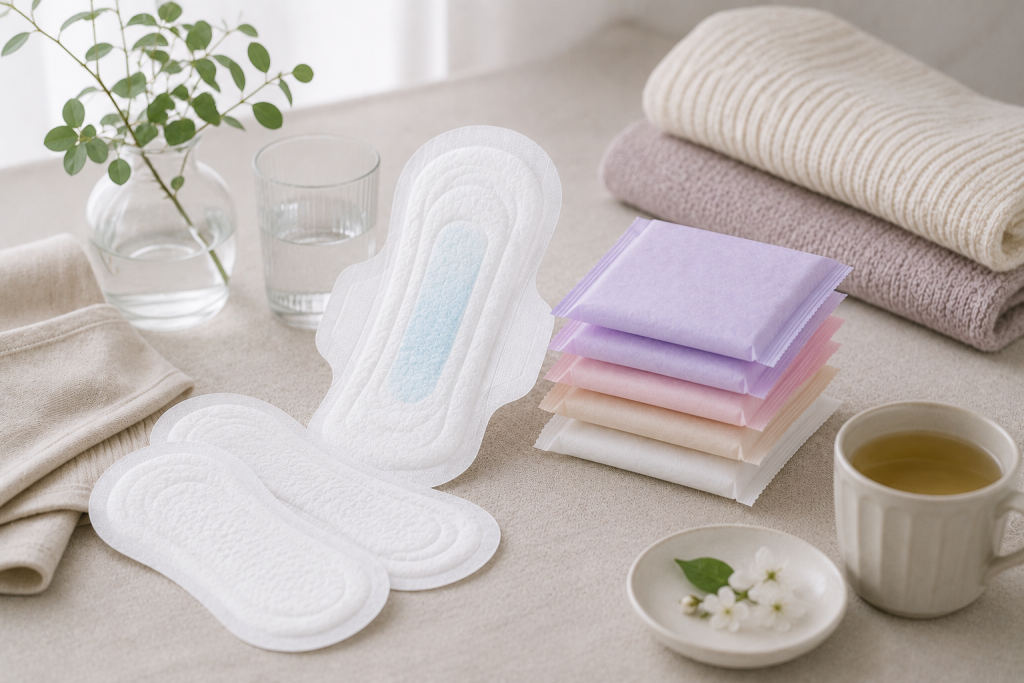
Heavy vs Overnight: Two Different Product Roles, Not One Absorbency Ladder
Heavy and overnight are usually treated as two steps on the same absorbency scale, with overnight simply being more. They are better understood as two roles solving different problems. Heavy addresses capacity during active daytime use. Overnight addresses coverage placement and position stability during a long period of stillness with intermittent movement. Specifying overnight as a longer heavy product is the most common cause of overnight underperformance.
Where this signal comes from: user discussions in menstrual product communities show buyers allocating different products to different situations within one cycle, distinguishing heavier daytime products from overnight products rather than treating them as one scale.
What each role is actually solving
The heavy role
The user is upright and moving. Liquid arrives at a higher rate, and the product must absorb quickly enough to keep the surface acceptable. The wear period is a few hours, with the option to change when convenient. The limiting factor is usually capacity and absorption speed.
The overnight role
The user is lying down for six to nine hours with no practical opportunity to change. Liquid travels differently depending on position, and position changes through the night. The limiting factor is usually coverage placement and whether the product stays where it was positioned — not total capacity.
This is why a user can move to a higher-capacity product and see no improvement overnight. They are increasing the variable that was not limiting.
Four specification differences
| Specification area | Heavy | Overnight |
|---|---|---|
| Primary driver | Capacity and absorption speed | Coverage placement and position stability |
| Coverage priority | Central and front coverage during upright movement | Front, rear and side coverage; effective width for side-lying |
| Wear duration assumption | A few hours, change when convenient | Full night, no opportunity to change |
| Displacement control | Moderate; user notices and adjusts | Critical; user is asleep and cannot adjust |
The last row is the one most often overlooked. During the day a user notices a product shifting and corrects it. Overnight nobody corrects anything, so a core that displaces during turning creates a gap that persists for hours.
Why one ascending scale fails
When a range is built as a single ladder — regular, heavy, super, overnight — the overnight SKU tends to be specified by scaling up the heavy SKU. In practice this means a longer product with more core, and it produces a predictable set of complaints:
- leakage at the front or rear despite the product being the longest option available
- side leakage during side-sleeping that does not respond to further length increases
- a bulky product that is uncomfortable to sleep in, without solving the coverage issue
- coverage that was adequate at the start of the night and not adequate after turning
None of these are capacity problems, so none of them are solved by adding capacity.
Testing each role differently
| Test | Heavy | Overnight |
|---|---|---|
| Absorption rate under load | Required | Useful, secondary |
| Directional leakage, reported separately | Useful | Required |
| Position testing: back, side, face-down, turning | Not applicable | Required |
| Core displacement after movement | Useful | Required |
| Compression recovery under sitting pressure | Required | Useful |
| Extended wet-state surface comfort | Useful | Required |
What to state on pack for each role
| Role | Useful pack wording |
|---|---|
| Heavy | For heavier days · Fast absorption · Change according to your flow |
| Overnight | Extended front-to-back protection · Wide absorbent coverage · Soft skin-contact layer · For heavier nights · Change according to your flow |
Avoid duration figures and absolute wording in both roles. Coverage and structure descriptions are accurate, comparable, and do not create expectations the product cannot control.
What this means for private label buyers
Give overnight its own specification sheet rather than deriving it from the heavy SKU. Define coverage placement, effective width and displacement control as primary values, and require directional leakage results reported separately.
Niceday manufactures overnight and daytime sanitary pads, panty liners, disposable menstrual pants and tampon products across 14 intelligent production lines in a 50,000 square meter facility in Foshan, China, with a daily capacity of 9.8 million pieces and export experience in 54+ countries. Standard MOQ is 300,000 pieces per SKU with a 35–40 day lead time.
Specify your overnight SKU separately
Send your current range structure and we will propose separate specifications and test plans for the heavy and overnight roles.
Email: winnie@everyniceday.com
Request a Specification ProposalFrequently Asked Questions
What is the difference between a heavy and an overnight product?
Heavy addresses capacity and absorption speed during upright, active use over a few hours. Overnight addresses coverage placement and position stability across a full night when the user cannot change or adjust the product.
Can an overnight SKU be derived from the heavy SKU?
It usually should not be. Scaling up a heavy product typically produces a longer product with more core, which does not address the coverage placement and displacement issues that cause overnight leakage.
Why does adding capacity not fix overnight leakage?
Because capacity is usually not the limiting factor. Overnight leakage is more often caused by the absorbent zone not reaching where liquid arrives in a given sleep position, or by the core displacing during turning.
Which tests are essential for an overnight product?
Directional leakage reported separately for front, rear and side; position testing covering back, side, face-down and a turning sequence; core displacement after movement; and extended wet-state surface comfort.
What should overnight packaging state?
Coverage and structure information such as extended front-to-back protection and wide absorbent coverage, with guidance to change according to flow. Duration figures and absolute leak claims should be avoided.