About This Guide
This page is an OEM sourcing guide for menstrual pants — also called period underwear or period pants. It is written for private label brand owners, importers, and distributors who are evaluating manufacturers and planning product development. It covers product types, material options, MOQ considerations, certifications, and key questions to ask before starting production.
What Are Menstrual Pants and Why Are They a Growing OEM Category?
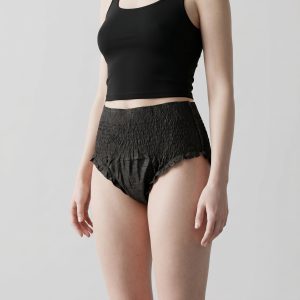
Menstrual pants — also referred to as period pants or period underwear — are absorbent underwear designed to replace or supplement traditional sanitary pads and tampons during menstruation. They are worn like regular underwear and absorb menstrual flow through a built-in absorbent layer, without the need for additional protection in most use cases.
For private label brands, menstrual pants represent a product category with strong growth in several key markets, including Europe, North America, and parts of Asia. Consumer interest in reusable, low-waste, and comfort-first period products has expanded the commercial opportunity for both disposable and reusable menstrual pants.
From an OEM perspective, menstrual pants require different manufacturing considerations than standard sanitary pads — including fabric sourcing, construction method, absorbency performance, and sizing — which makes manufacturer selection especially important.
Disposable vs. Reusable Menstrual Pants: What Brand Owners Should Know First
Before approaching a manufacturer, brand owners need to decide which product route they are planning. The two main options are fundamentally different in terms of manufacturing process, materials, target consumer, and market positioning.
| Factor | Disposable Menstrual Pants | Reusable Menstrual Pants |
|---|---|---|
| Primary material | Nonwoven fabric, SAP core, PE film | Woven or knit fabric, absorbent textile layers |
| Manufacturing process | Similar to sanitary pad production lines | Garment-style cut and sew production |
| Consumer use | Single use, disposed after wear | Washed and reused, typically 50–100+ wash cycles |
| Market positioning | Convenience, travel, postpartum use | Sustainability, cost saving, lifestyle |
| Typical MOQ | Higher per SKU due to production line setup | Variable depending on size range and styles |
| Certification focus | Similar to sanitary pad compliance | Textile safety standards, OEKO-TEX common |
Most sanitary products manufacturers — including those who produce sanitary pads at scale — specialize in disposable menstrual pants rather than reusable textile versions. If your brand requires reusable menstrual pants, confirm the manufacturer's production capability explicitly before proceeding.
Key OEM Considerations for Menstrual Pants
1. Absorbency Performance
Absorbency is the most critical performance factor for menstrual pants. It determines how long the product can be worn comfortably, how well it prevents leakage, and how it is positioned relative to light, medium, or heavy flow use. Brand owners should specify absorbency expectations clearly and request performance data from the manufacturer before sample confirmation.
2. Material and Surface Construction
The surface material directly affects product comfort and consumer experience. Common options include:
- Soft nonwoven topsheet — standard for disposable menstrual pants, similar to sanitary pad construction
- Organic cotton surface — relevant for skin-comfort and natural product positioning
- Breathable backsheet — important for wearer comfort during extended use
Material selection also affects compliance requirements and any product claims the brand intends to make.
3. Sizing and Fit
Unlike standard sanitary pads, menstrual pants need to fit correctly as a wearable garment. For disposable menstrual pants, sizing options typically cover standard underwear size ranges. Brand owners should confirm what size range the manufacturer supports and whether size-specific SKUs are available within the MOQ structure.
4. Packaging Customization
Menstrual pants are often sold individually or in small packs, which means packaging design plays a strong role in shelf appeal and consumer confidence. Buyers should confirm whether the manufacturer can support custom packaging including brand artwork, multi-language labeling, and format options appropriate for retail or e-commerce presentation.
5. Private Label and Branding Support
A capable OEM manufacturer should be able to adapt the product to your brand's positioning — including material specification, design direction, and packaging — rather than simply applying a label to a standard product. This is especially relevant in markets where differentiation matters.
What Certifications Are Relevant for Menstrual Pants OEM?
Certification requirements for menstrual pants depend on the target market and product type. Brand owners should confirm which certifications their market requires before selecting a manufacturer.
- ISO 9001 — quality management system baseline, relevant across markets
- CE marking — relevant for European market access
- FDA registration — relevant for the US market
- SGS / Intertek testing — third-party raw material and finished product safety testing
- OEKO-TEX Standard 100 — relevant for textile safety, especially for reusable products or organic material claims
- GOTS / OCS — required if organic cotton content is part of the product claim
Always request original certification documents from the manufacturer and verify that the issuing company matches the factory you are working with. For a broader overview of certification considerations in feminine hygiene OEM, see our guide on what certifications matter for feminine hygiene OEM.
MOQ and Lead Time: What to Expect for Menstrual Pants OEM
MOQ and lead time for menstrual pants OEM projects depend on several factors, including product type, level of customization, and packaging complexity.
- MOQ — for fully customized disposable menstrual pants, MOQ is typically higher per SKU due to production line setup requirements. Brand owners planning a multi-size range should discuss per-size and per-SKU MOQ separately with the manufacturer.
- Lead time — typical lead time from confirmed specifications to shipment-ready production is generally 35–45 days for standard OEM projects, depending on sample revision rounds and packaging production time.
- Sampling — a structured sampling process is essential before bulk production. Buyers should allow time for at least one round of sample review and, if needed, one revision round before bulk confirmation.
For a more detailed explanation of how MOQ, packaging timelines, and lead time interact across feminine hygiene OEM projects, see our article on OEM sanitary pads: MOQ, packaging, and lead time explained.
Questions to Ask a Menstrual Pants Manufacturer Before Starting
Before committing to a manufacturer for menstrual pants OEM, buyers should ask the following:
- Do you specialize in disposable or reusable menstrual pants, or both?
- What absorbency levels and size ranges can you produce?
- Can you customize the topsheet material, including organic cotton options?
- What is the MOQ per SKU for a fully customized product?
- What certifications do you hold, and can you provide original documentation?
- What does your sample development process look like, and how long does it typically take?
- Can you support custom packaging with brand artwork and multilingual labeling?
- Do you have experience supplying buyers in my target market?
Frequently Asked Questions
What is the difference between menstrual pants and period underwear?
Menstrual pants and period underwear refer to the same product category — absorbent underwear designed to be worn during menstruation. "Period underwear" is the more common consumer-facing term in English-speaking markets, while "menstrual pants" is also widely used in trade and sourcing contexts. In OEM discussions, both terms are used interchangeably.
Are menstrual pants considered a medical device?
In most markets, disposable menstrual pants are classified similarly to sanitary pads — as hygiene products rather than medical devices. However, classification can vary by country and regulatory framework. Brand owners should confirm the regulatory category applicable in their target market before finalizing product development and claims.
Can the same manufacturer produce both sanitary pads and menstrual pants?
Many sanitary pad manufacturers also produce disposable menstrual pants, as the core construction and production process are closely related. Buyers already working with a sanitary pad OEM manufacturer can often discuss menstrual pants as an additional SKU within the same product development framework.
What is a realistic MOQ for menstrual pants OEM?
MOQ varies by manufacturer and customization level. At Niceday, our standard MOQ for OEM projects is 300,000 pieces per SKU. For menstrual pants specifically, buyers should discuss size range structure and per-size MOQ directly with our team to find the most practical configuration for their project.
How are menstrual pants different from postpartum underwear?
While both are worn as underwear with absorbent function, menstrual pants are designed for period use, while postpartum underwear is designed for the recovery period after childbirth, which involves higher absorbency requirements and different sizing considerations. Some brands carry both products within their feminine hygiene line. For postpartum underwear OEM, see our guide on disposable postpartum underwear for private label brands.
Planning a Private Label Menstrual Pants Line?
Niceday is a feminine hygiene OEM manufacturer based in Foshan, China, with 14 production lines and daily output capacity of 9.8 million pieces. We support private label brand owners and distributors with product customization, packaging development, and export-ready manufacturing for menstrual pants and related feminine hygiene categories.
Tell us about your project — target market, product type, and expected order scale — and we will respond with relevant capability information and next steps.
Contact Our OEM Team View OEM Service Details