Disposable postpartum underwear is one of the fastest-growing categories in maternity care, and one of the most under-supplied in private label programs. Many brands sell maternity pads but do not yet offer an absorbent postpartum pant, even though hospitals, maternity retailers, and online mother-and-baby brands increasingly ask for it. This guide explains what disposable postpartum underwear is, how the product is constructed, what brand owners can customize, and what to check before choosing an OEM manufacturer.
What Is Disposable Postpartum Underwear?
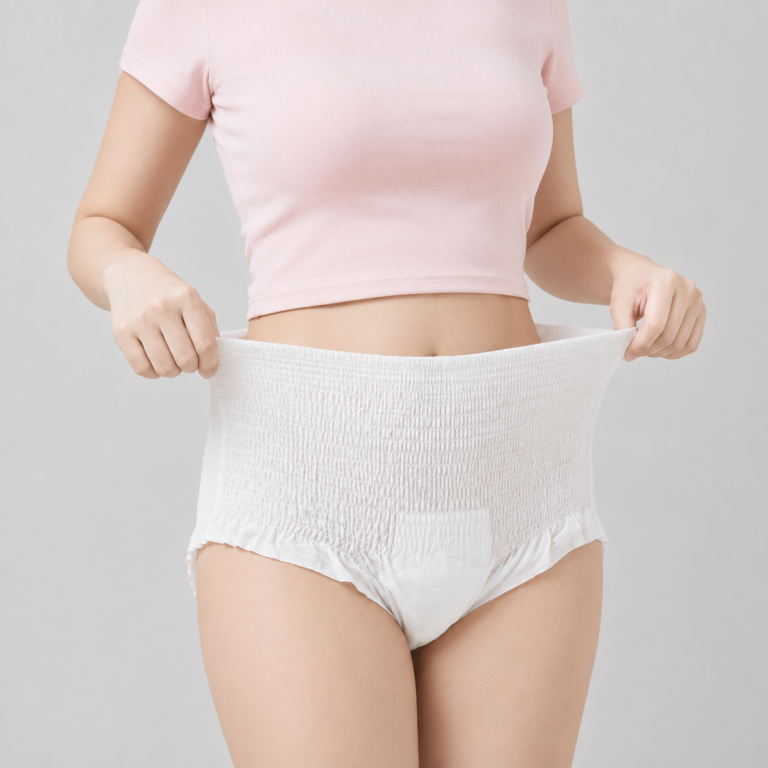
Disposable postpartum underwear (also called disposable postpartum pants or maternity briefs) is a pull-on absorbent garment worn in the days and weeks after childbirth. Postpartum flow is heavier than a normal period, especially in the first days, and movement is frequent — getting in and out of bed, feeding, carrying a newborn. A pant-style product stays in place better than a pad and covers a much larger absorbent area, including the back panel for lying-down protection.
From a manufacturing point of view, the product is closely related to disposable menstrual pants, but with a higher-capacity absorbent core, a softer and looser waist design for post-birth comfort, and sizing that accommodates a changing postpartum body.
Why Brands Are Adding This Category
- Clear usage occasion: nearly every new mother needs heavy-flow protection for 2–6 weeks, making repeat purchase predictable.
- Higher unit value: postpartum pants sell at a higher price point than pads, improving margin per SKU.
- Natural bundle logic: the product pairs directly with maternity pads, breast pads, and wipes in hospital-bag kits and postpartum boxes.
- Channel demand: maternity e-commerce, pharmacies, and hospital supply channels are actively sourcing this category, and supply is still limited compared with regular pads.
Product Structure and Key Components
Typical construction
- Top sheet: soft non-woven or organic cotton surface for gentle skin contact.
- Absorbent core: high-capacity fluff pulp and SAP core, usually rated for heavy postpartum flow; core length often 350 mm or longer with extended back coverage.
- Waistband: soft, high-stretch elastic waist designed to sit comfortably without pressing on the abdomen — an important comfort point for post-birth and post-cesarean wear.
- Leg cuffs: elastic barriers for side-leakage protection.
- Backsheet: breathable PE or laminated non-woven outer layer.
Common size range
Postpartum sizing usually runs larger and stretchier than standard menstrual pants. A typical private label range covers M through XXL, and some brands add a one-size high-stretch option for hospital kits.
Disposable Postpartum Underwear vs. Other Postpartum Options
| Option | How it works | Best fit | Private label consideration |
|---|---|---|---|
| Disposable postpartum underwear | All-in-one absorbent pant, single use | First days and nights, heavy flow, hospital stay | Highest convenience positioning; premium price point |
| Mesh underwear + maternity pad | Reusable stretch mesh brief holding a separate pad | Hospital supply, budget kits | Lower cost but requires two SKUs and correct pad pairing |
| Maternity pads alone | Extra-long heavy-flow pads worn with regular underwear | Later postpartum weeks, lighter flow | Natural companion SKU rather than substitute |
Most successful postpartum ranges include both the pant and the pad: the pant for the heaviest early days, and maternity pads for the transition weeks that follow.
What Brand Owners Can Customize
- Absorbency level: core weight and SAP ratio adjusted for heavy postpartum flow or overnight positioning.
- Surface material: standard soft non-woven, cotton-feel, or organic cotton top sheet for a premium natural positioning.
- Size curve: M–XXL, or a simplified one-size hospital-kit version.
- Pack format: counts of 4–10 per pack are common for postpartum products, often in resealable soft packs or gift-style boxes for postpartum kits.
- Branding and packaging: full private label design, multilingual packaging, and retail or e-commerce-ready formats.
Details of the customization workflow — specification confirmation, sampling, packaging design, and bulk production — are explained on our OEM/ODM service page.
How to Evaluate a Disposable Postpartum Underwear Manufacturer
Before committing to a supplier, buyers should check:
- Pant-production capability: pull-on pants require different equipment from pads. Confirm the factory runs dedicated pant lines, not only pad lines.
- Absorbency testing: ask for absorption capacity and rewet test data for the postpartum core, ideally verified by third-party testing such as SGS.
- Material safety: confirm the product is free of fluorescent brightening agents and that surface materials suit sensitive postpartum skin positioning.
- Certifications: ISO 9001 and ISO 14001 quality and environmental management, plus CE and FDA registration where your target market requires them.
- Commercial terms: confirm MOQ, lead time, and sampling process in writing before packaging design begins.
Niceday Manufacturing Capability
Niceday is a feminine hygiene manufacturer based in Foshan, China, operating a 50,000 m² facility with 14 intelligent production lines and a daily capacity of 9.8 million pieces across sanitary pads, panty liners, menstrual pants, and related categories. Products are exported to 54+ countries, and quality management is supported by ISO 9001, ISO 14001, CE, FDA registration, and SGS testing.
For disposable postpartum underwear, typical OEM terms are an MOQ of 300,000 pieces per SKU and a production lead time of 35–40 days after order confirmation, with sampling and packaging development supported before bulk production.
Frequently Asked Questions
What is the MOQ for private label disposable postpartum underwear?
The typical MOQ is 300,000 pieces per SKU. Exact terms depend on size curve, materials, and packaging structure, so MOQ should be confirmed during specification discussion.
How long does OEM production take?
Standard lead time is 35–40 days after order and artwork confirmation. Sampling and packaging development are completed before bulk production begins.
Can postpartum underwear use an organic cotton top sheet?
Yes. An organic cotton surface is a common premium option for postpartum products, since many buyers position the range around gentle, natural materials for sensitive postpartum skin.
What is the difference between postpartum underwear and regular period pants?
Postpartum underwear uses a higher-capacity absorbent core, extended back coverage, a softer and looser waistband, and a larger size curve. Regular period pants are designed for normal menstrual flow and a standard fit.
Can the product be included in a postpartum kit with other items?
Yes. Postpartum underwear is frequently bundled with maternity pads, breast pads, and wipes in hospital-bag kits. Niceday supports coordinated packaging design across these SKUs.
Start Your Postpartum Product Line
Discuss specifications, sampling, packaging, and pricing for disposable postpartum underwear with our OEM team.
Request a Quote