About This Guide
This guide covers feminine hygiene during menstruation — what it means in practice, how sanitary napkin pads support it, what product and material factors matter most, and how to choose the right product for different needs. It is written for consumers seeking practical guidance, and for brand owners and importers who want to understand the product category before evaluating private label or OEM manufacturing options.
What Is Feminine Hygiene and What Does It Involve During Menstruation?
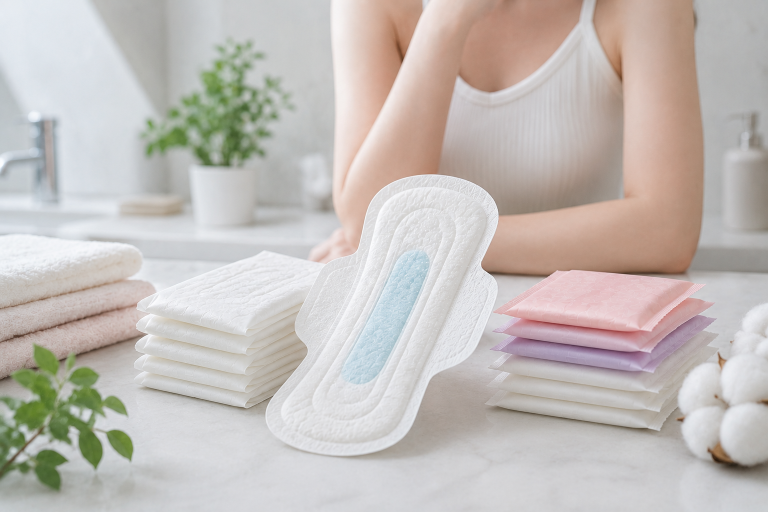
Feminine hygiene refers to the care and cleanliness of the intimate area during everyday life and especially during menstruation. During a period, the body sheds the uterine lining — a process that involves blood and tissue that needs to be absorbed and managed externally to maintain comfort and cleanliness.
Good menstrual hygiene practice involves:
- using an appropriate absorbent product — pad, tampon, menstrual cup, or period underwear — matched to current flow level
- changing the product at appropriate intervals to prevent bacterial growth from prolonged moisture exposure
- cleaning the external intimate area with mild, unscented soap or warm water during product changes
- using breathable, comfortable underwear to support air circulation
- disposing of used products hygienically
The choice of menstrual product plays a significant role in how well these hygiene goals are achieved. A product that absorbs poorly, irritates the skin, or requires infrequent changing creates hygiene risks regardless of other care habits.
What Are Sanitary Napkin Pads and How Do They Work?
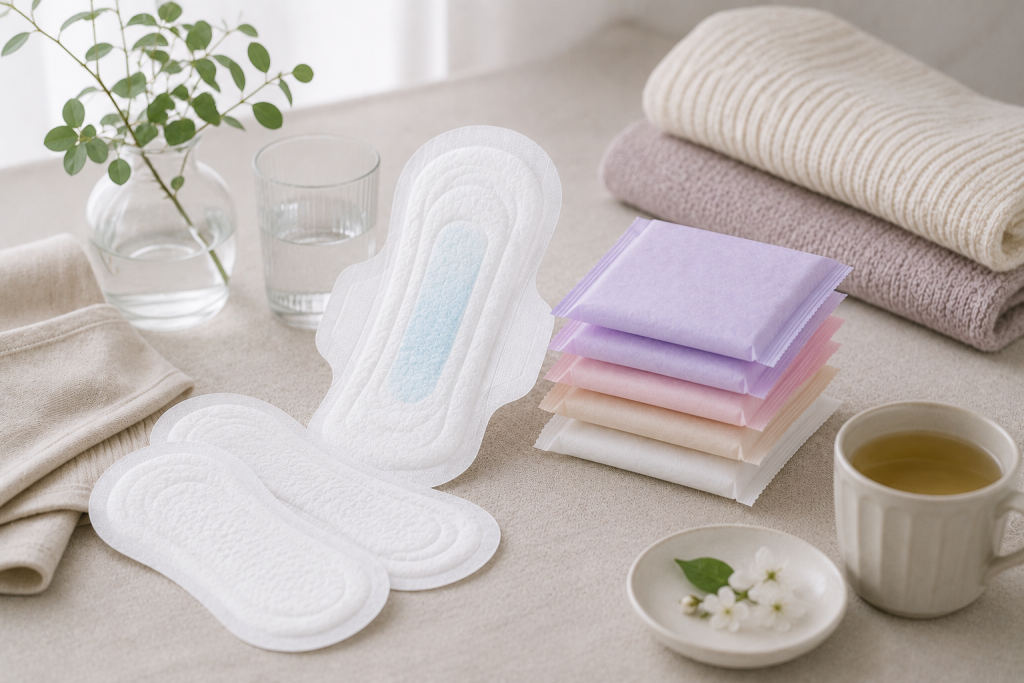
Sanitary napkin pads — also called menstrual pads or sanitary pads — are absorbent products worn externally inside the underwear to absorb menstrual flow. They are the most widely used menstrual product globally, across all markets and age groups.
A modern sanitary pad is a multi-layer product. Each layer has a specific function:
| Layer | Function | Quality Indicator |
|---|---|---|
| Topsheet | Transfers fluid into the core; stays in contact with skin | Fast fluid transfer, soft surface, fragrance-free |
| Distribution layer | Spreads fluid across the core for even absorption | Even fluid distribution, prevents core saturation in one spot |
| Absorbent core | Holds fluid; prevents it returning to surface under pressure | Appropriate SAP concentration, structural integrity during wear |
| Backsheet | Prevents fluid from passing through to underwear | Leak-proof, breathable to reduce heat buildup |
| Side leak barriers | Prevent side leakage during movement | Flexible, maintains contact with body during activity |
| Adhesive and wings | Secure pad position in underwear | Strong adhesion, wings wrap securely without bulk |
The hygiene effectiveness of a pad depends on all these layers working together — not on any single feature or marketing claim.
Why Pad Material Matters for Skin Health
Because sanitary pads are worn in contact with sensitive skin for several hours at a time, the materials used directly affect skin comfort and hygiene outcomes. Poor material choices are one of the most common causes of irritation, redness, and discomfort during menstruation — problems that are often attributed to "sensitive skin" but are actually caused by avoidable product ingredients.
Key material factors that affect skin health:
- Fragrance-free — synthetic fragrances added to pads are a leading cause of contact irritation. A pad that smells strongly of perfume or "freshness" is more likely to irritate sensitive skin than one that is fragrance-free.
- FBA-free (no fluorescent brightening agents) — fluorescent brightening agents are sometimes used in textile and paper manufacturing to make materials appear whiter. Their presence in products worn against sensitive skin is associated with irritation in some users. FBA-free is a verifiable claim through third-party testing.
- Chlorine-free processing — chlorine bleaching can leave trace chemical residues in absorbent materials. Chlorine-free or elemental chlorine-free processing reduces this risk.
- Topsheet material — organic cotton topsheets are generally softer and less likely to cause friction-related irritation than some synthetic nonwoven alternatives, particularly for users who wear pads for extended periods or have sensitive skin.
For consumers, checking for these material attributes is more useful than relying on general "gentle" or "natural" marketing language, which is unverified. For brand owners, these attributes are verifiable through third-party test reports and are meaningful product differentiation points in markets where consumers are increasingly aware of ingredient transparency.
Hygiene Best Practices When Using Sanitary Pads
Choosing a good pad is one part of menstrual hygiene. How the pad is used is equally important.
- Change regularly — change pads every 3–6 hours during regular flow and every 2–3 hours during heavy flow. Do not leave any pad on for more than 8 hours. Regular changing is the most important hygiene practice regardless of pad quality or material.
- Match absorbency to flow — using a pad with insufficient absorbency for current flow creates moisture exposure at the skin surface. Using an appropriate absorbency level keeps the surface drier for longer.
- Clean the external area during changes — mild unscented soap or warm water is sufficient. Avoid scented intimate washes or products marketed as "balancing" that may disrupt natural skin pH.
- Wear breathable underwear — cotton or breathable fabric underwear supports air circulation and reduces the heat and moisture buildup that can occur with extended pad wear.
- Dispose correctly — wrap used pads in the wrapper from the new pad or in toilet paper before placing in a bin. Do not flush pads — even biodegradable versions can block drainage systems.
Sanitary Napkin Pads Across Different Use Occasions
Sanitary pads are not a single product — the category spans a wide range of formats designed for different flow levels and use situations. Choosing the right format for the occasion is part of effective hygiene management.
- Panty liners — for light discharge, spotting, or everyday freshness outside of peak period days; very thin and designed for comfortable all-day wear
- Regular day pads — for light to moderate flow during daytime hours; standard absorbency for most period days
- Heavy / maxi pads — for heavier flow days when standard pads need changing too frequently; higher SAP concentration and stronger leak barriers
- Overnight pads — for sleep protection; extended length and wider back panel provide coverage during lying-down positions and longer wear without changing
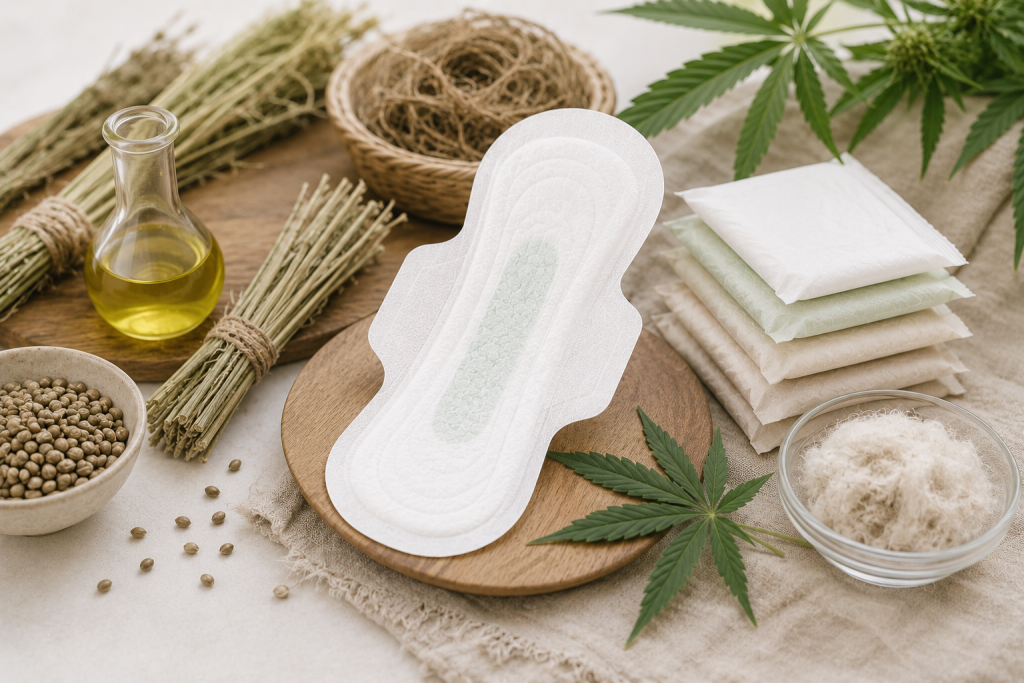
- Organic cotton pads — available across all absorbency levels; organic cotton topsheet for softer surface contact and skin-comfort positioning
For a detailed overview of pad types, construction, and how to choose the right product for different needs, see our guide on women's pads for period and feminine hygiene.
Frequently Asked Questions
How often should sanitary pads be changed for good hygiene?
Every 3–6 hours during regular flow, every 2–3 hours during heavy flow, and within 8 hours for overnight use. Changing regularly — regardless of whether the pad appears saturated — prevents bacterial growth from prolonged moisture contact and is the most important single hygiene practice in pad use.
Can sanitary pads cause infections?
Correctly used sanitary pads do not cause infections. However, leaving a pad on for too long, using pads with irritating materials such as synthetic fragrances or fluorescent brightening agents, or wearing non-breathable underwear can create conditions that increase infection risk. Choosing fragrance-free, FBA-free pads and changing them regularly significantly reduces this risk.
Are organic cotton pads better for feminine hygiene?
For users with sensitive skin or those who experience irritation from conventional pads, organic cotton topsheets — combined with fragrance-free and FBA-free construction — are generally a better fit. They are not inherently more hygienic than well-made conventional pads, but the absence of synthetic fragrances and brightening agents reduces the likelihood of chemical-related irritation. Absorbency and change frequency remain the most important hygiene factors regardless of topsheet material.
What is the difference between a sanitary pad and a sanitary napkin?
"Sanitary pad," "sanitary napkin," and "menstrual pad" all refer to the same product — an external absorbent product worn in the underwear during menstruation. "Sanitary napkin" is more commonly used in North American English and in trade and manufacturing contexts; "sanitary pad" is more common in British English and international usage. Both terms are used interchangeably across markets and in OEM sourcing discussions.
For brand owners: what makes sanitary napkin pads a strong private label category?
Sanitary napkin pads are the largest product category in feminine hygiene globally — used by most menstruating people across all markets, with consistent monthly repurchase cycles. For private label brands, the category offers strong baseline demand, clear product differentiation opportunities through material and positioning choices, and a well-established OEM manufacturing supply chain. The main challenge is differentiation in competitive markets — which is why material positioning, packaging quality, and market-specific product fit matter more than price alone for new brands entering the category.
For Brand Owners and Importers: Sanitary Napkin Pads as an OEM Category
Sanitary napkin pads represent the core of the feminine hygiene OEM market. For importers, distributors, and private label brand owners, this category offers:
- Consistent demand — monthly repurchase cycles driven by biological necessity, not discretionary spending
- Wide market reach — the category is relevant across virtually all markets and demographics
- Clear differentiation paths — organic cotton, herbal-inspired concepts, functional freshness positioning, and premium packaging each offer distinct brand positioning directions
- Established manufacturing supply chain — OEM manufacturing for sanitary pads is well-developed, with manufacturers capable of supporting product customization, packaging development, and export documentation
For new brand owners evaluating where to start, sanitary napkin pads are typically the anchor SKU of a feminine hygiene range — complemented over time by panty liners, menstrual pants, and other categories as the brand grows.
For a complete overview of how to plan and launch a private label feminine hygiene brand starting with sanitary pads, see our guide on how to start a private label feminine hygiene brand. For manufacturer evaluation, see our guide on how to choose a sanitary pad manufacturer.
Looking for a Sanitary Napkin Pad OEM Manufacturer?
Niceday manufactures sanitary napkin pads across a full range of absorbency levels and material directions — including organic cotton, herbal-inspired, and functional freshness product concepts. Our products are manufactured FBA-free and fragrance-free as standard, with ISO 9001 certified quality management and third-party tested raw materials. We supply private label brands and distributors in 54+ countries from our facility in Foshan, China.
Tell us your target market, product direction, and quality requirements — our OEM team will respond with relevant capability information and next steps.
Contact Our OEM Team View OEM Service Details